A proven layout system as the starting point
Not a blank page, and not a rigid template you are stuck inside either.
Pick the book you write. Each page shows the pages, the quote form and the plan that fit it.
See all agency typesProperty and casualty
What the site carries and what we keep running for you, with the plan each one sits on.
See all featuresWhere quotes start
Design and build
Search, redesign and scale
Reading, answers and the people who write them.
Plans $127 a monthLive in 7 days$697 build fee, invoiced after launchDomain and hosting included
Design and build
Search, redesign and scale
A template gives an agency a professional-looking layout in an afternoon, which is genuinely useful when the alternative is a blank page and a launch deadline, but a template stops well short of what actually starts a quote: line-specific forms, integration into an AMS, and content written for your book rather than a placeholder. Knowing where the template's job ends and the real build begins is the difference between a site that looks done and a site that works.
What it costs
Who it is for
Agencies weighing a ready-made insurance template against a site built for their own lines, carriers and towns.
If two or more of the signs on this page sound familiar, this is the page for you.
Your template lists lines you do not write and misses the ones you do.
The template's quote form emails you a wall of unstructured text.
Every other agency in town seems to have the same layout.
Updating the template breaks something each time.
Everything below ships on every plan, alongside hosting, a free domain, weekly updates and researched articles.
Not a blank page, and not a rigid template you are stuck inside either.
Per-line forms replacing the generic contact form every template ships with.
The part templates never include, built and verified before launch.
No placeholder paragraphs; pages written for your lines, towns and carriers.
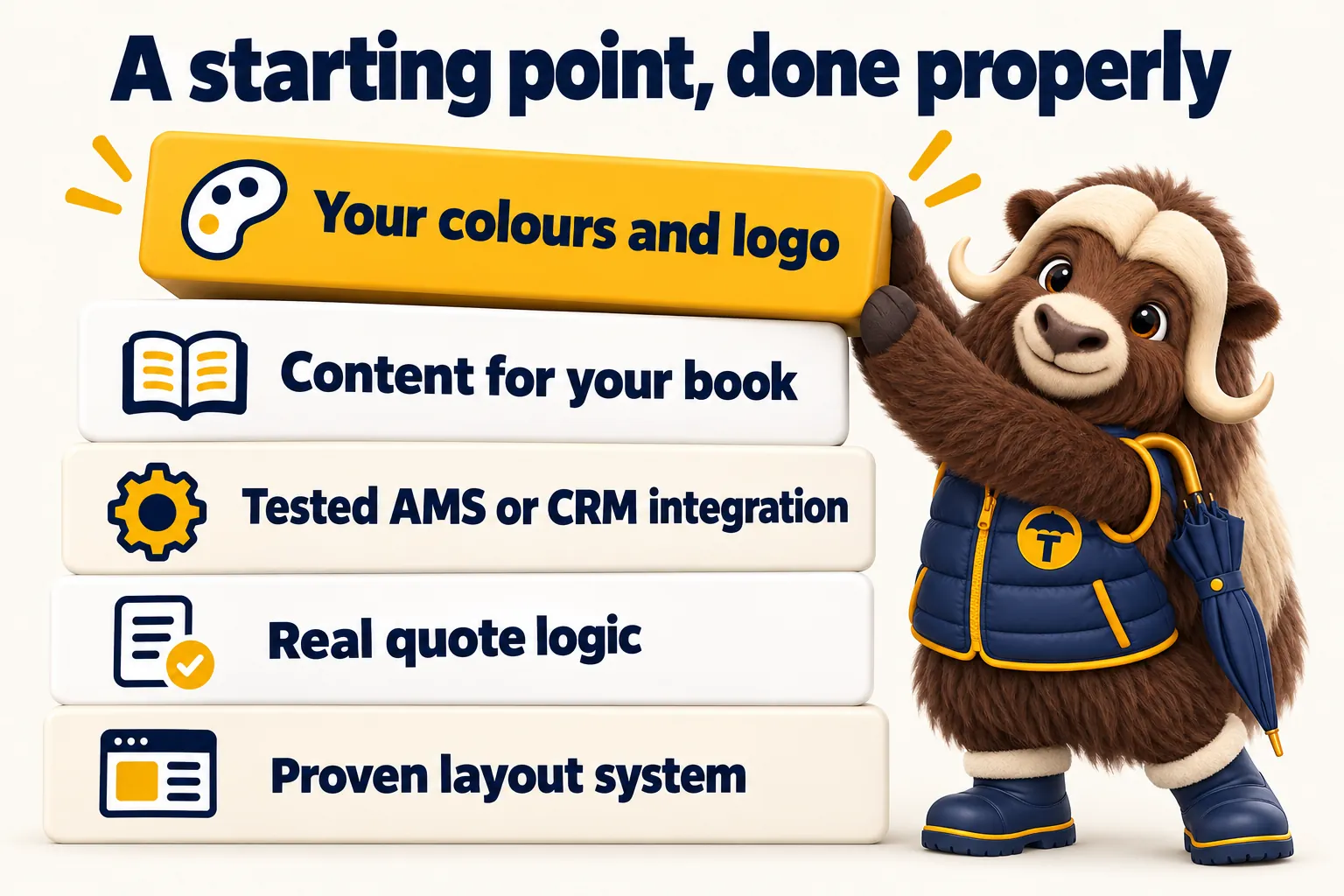
The starting layout is rebuilt around your brand, not left generic.
The speed benefit of a starting point, without the template's gaps.
A template solves layout and visual structure fast: a homepage grid, a header and footer, a colour scheme, typography that does not clash, spacing that looks intentional rather than accidental. For an agency that needs something online quickly, a decent template beats a blank page by a wide margin, and there is no reason to reinvent a header layout or a footer grid that a hundred other sites have already solved reasonably well over the years. This is the part of the job templates were built for, and they genuinely do it fine, which is exactly why they remain a sensible starting point rather than something to avoid on principle.
Most templates ship a generic contact form, styled to match the theme, with no logic specific to insurance and no sense of what a producer actually needs to open a file. Turning that into an auto quote form that asks for drivers and vehicles, or a BOP form that asks for business type and location, is custom work a template does not include, and it is the single most important page on the entire site. A template that looks finished with its default form is not actually finished for an insurance agency, no matter how polished the surrounding pages look.
A template's form, once rebuilt with the right fields, still has to land somewhere useful for a producer to act on it quickly. Connecting it to EZLynx, HawkSoft, AMS360, Applied Epic or another AMS is not a template feature; it is a development task that has to be done and tested separately, regardless of how good the visual design looks on the surface. A beautiful form that emails a generic inbox nobody checks reliably is not meaningfully better than no form at all, and can actually be worse, since it creates the illusion that leads are being captured.
A template ships with placeholder content, "Home Insurance" as a heading and a paragraph of stock text describing coverage in the vaguest possible terms, which does nothing for search and reads as generic to a visitor who can tell within seconds that the page was never actually written for them. The pages that actually earn traffic, one per line crossed with one per town, still have to be written for your agency, your carriers and the towns you serve, which is content work no template automates no matter how many pages it ships with by default.
We do not sell finished templates; the first designs are still landing, and every site we build starts from a proven layout system and is then rebuilt around your lines, your towns, your carriers and your quote forms before it goes live. That gets you the speed benefit of a starting point without leaving the quote logic, integrations and content as your homework to finish later, all for $127 a month with the $697 build fee invoiced after launch once you have seen and approved the finished site.
Plain about the edges, so nothing surprises you later.
See insurance website templates applied to your own agency on a half-hour demo. Plans $127 a month.
Book the demoThe starting point was our own sent mail, not a template, and it shows. Nothing went live until the person responsible for that subject had signed off the answer. The phone calls about basic personal coverage inquiries details have noticeably thinned out.
The preparation page for personal coverage inquiries works because it keeps its focus. It explains what the first conversation needs, and deliberately asks for nothing sensitive online. First conversations are shorter and better because of it.
$127, $267 or $647 a month
Single Line, Multi-Line, Agency Book. The plan, not the page count, sets the price.
$697 build fee, after launch
Invoiced once the site is live and you have approved it. Never up front.
Live in 7, 10 or 15 days
By plan, counted from the onboarding call, once we have your lines, carriers and towns.
What moves the price
Only the plan you choose, AI usage at cost on the AI plans, and revisions beyond 5 a month.
Four steps, and you pay for the build only after you have seen it live.
Every visitor ready to shop leaves through a phone number, or leaves nothing at all.
Pick a plan on the pricing page. The first month is the only thing you pay before the site exists.
We do not yet know your lines, your carriers, your towns or the system your producers work in.
Lines you write, carriers you are appointed with, towns you serve, producers, and which CRM or AMS the requests go into. Anything missing can follow later by email or as a portal ticket.
Not one line you write and not one town you serve has a page of its own.
Pages, quote forms, integrations, articles queued. You review a live link and send changes as revisions.
The build is not paid for, and you have not seen the site it paid for.
Once the site is live and you have approved it, we invoice the $697 one-time build fee. Not before.
See it live before the build fee
You approve the live site first.
90+ PageSpeed, or we fix it
On every page we build and host, at no charge.
No contract term
Cancel with 2 business days notice before your next invoice; keep your domain and content.
Built with US rules in mind to help you meet them; you approve the final wording.
Client builds where this work did the heavy lifting, each with the timeline and the outcome.
Case file 05
I send the personal coverage inquiries guide and the preparation is done. The daily ritual of rewording the same email is over.
When it comes to personal coverage inquiries, messages arrive pre-sorted by the person best placed to sort them: the sender.
With personal coverage inquiries, the person asking, the person approving and the person publishing all look at the same words.
Not as a standalone product right now; the first published designs are landing soon. Every site we build starts from a proven layout system that is then rebuilt around your specific lines, towns, carriers and forms before it goes live, which gets you the speed of a template without its gaps.
Nothing, as a starting point for layout. The problems show up afterward: rebuilding the contact form into real per-line quote logic, connecting it to your AMS, and writing content for every line and town, all of which are separate jobs a theme purchase does not include.
Book a demo and we build a live walk-through of a site for your kind of agency, in your colours, with your lines and towns, so you see the real result rather than a generic theme preview.
7 days on Single Line, from the onboarding call to launch, counted once we have your lines, carrier appointments and CRM or AMS details.
They start from a proven structure for agency sites, then the pages, forms and copy are built for your lines, carriers and towns. You never get a template with the placeholder text swapped.
We show designs on the demo call built around your own agency rather than a gallery of fictional ones, and you choose the direction.
The structure is proven, but colors, type, photography and copy are your own, so the site reads as your agency.
As fast as the plan: 7 days on Single Line, counted from the onboarding call.
A live walk-through of the site you would get, in about 30 minutes. Plans from $127 a month, the $697 build fee invoiced only after launch, domain and hosting included.
Book a demoOr email and a person replies within one working day.
GetInsuranceWebsite uses the cookies below. Necessary cookies keep the site working and cannot be turned off.
Saved on this device only. Press Esc to close.