Everything in a GetInsurance insurance agency website
The short answer: a site with a quote form for every line you write, pushed into your CRM or AMS, kept fast, found in search and updated every week. 11 features below; everything above the AI Engine ships on every plan, the AI Engine is on Multi-Line and Agency Book, and the Content Engine on Agency Book only.
Every feature, every plan
What is in each plan: every item, what it solves and what you do
28 things you get, in plain words. Everything marked "Every plan" ships on Single Line at $127 a month; Multi-Line adds the AI Engine and Agency Book adds the Content Engine on top.
- Single Line $127 / month
- Multi-Line $267 / month + usage
- Agency Book $647 / month
The website and where quotes start
A quote request form for every line you write
A short form per line (auto, home, renters, umbrella, BOP, general liability, workers comp, life, Medicare, group benefits) asking only what a producer needs to open the quote.
- Solves
- One generic "contact us" form that turns every prospect into a blank conversation your CSR has to chase.
- You do
- Approve the fields on each form before launch.
A page for every line of business
Each line gets its own page that explains the coverage in general terms and ends with that line's form.
- Solves
- A single "Products" page that ranks for nothing and makes a shopper hunt.
- You do
- Tell us the lines you write on the onboarding call.
Location pages for the towns and counties you serve
A page written for each real place you serve, crossed with the lines you write there, matched to your Google Business Profile.
- Solves
- Being invisible to people searching for coverage in the next town over.
- You do
- List the towns and counties; we write the pages.
Carrier pages and a claims and billing directory
A page per featured carrier in general terms, plus every carrier's claims line, billing line and portal on one page.
- Solves
- Clients calling the office at night to ask for a claims number.
- You do
- Nothing after onboarding. We keep the numbers current.
Requests into your CRM or AMS, routed to the right producer
Every request lands in EZLynx, HawkSoft, AMS360, Applied Epic, HubSpot, GoHighLevel or another system, tagged by line and page, with an email and a text to the producer on duty.
- Solves
- Requests sitting in an inbox nobody checks after five, and re-keying into the AMS.
- You do
- Tell us the system and the routing; approve one test submission.
Privacy, terms, cookie and accessibility pages, plus your disclaimer wording
A privacy policy, terms, a cookie policy with a consent banner that holds tracking scripts back until the visitor agrees, an accessibility statement, and the disclaimer wording you supply for your states on every page.
- Solves
- A site with no policies, or policies copied from a template for a different kind of business.
- You do
- Supply your agency's disclaimer wording and license details; have your own counsel review them if you wish.
Single Line launches in 7 days, Multi-Line in 10 and Agency Book in 15, counted from the onboarding call.
- Solves
- Web projects that drift for months while the old site keeps losing requests.
- You do
- Send your lines, carriers, towns and license numbers; review the live link.
Move from your current site without losing its pages
Your old site stays up until you approve the new one, and every old URL gets a 301 redirect to its new page. Existing forms are reconnected to the same system.
- Solves
- The fear of throwing away the pages people already find you through.
- You do
- Nothing beyond approving the new site.
Speed, search and AI answers
90+ PageSpeed on every page we build
Static pages served from Cloudflare's edge with almost no script. If a page we control drops below 90+, we fix it at no charge.
- Solves
- Phone visitors leaving before the page, and the form at the bottom of it, ever loads, including the ones you paid for with ads.
- You do
- Nothing. You can run the test yourself on launch day.
Clean URLs, one clear heading per page, unique titles and descriptions, internal links between line, town and carrier pages, an XML sitemap and correct redirects.
- Solves
- Ranking for your own agency name and nothing else.
- You do
- Nothing.
Structured data (JSON-LD) on every page
The agency as an organization or local business, each line as a service, each FAQ as a question and answer, breadcrumbs, and each article with its author.
- Solves
- Search engines and AI assistants guessing what your agency is and where it works.
- You do
- Confirm your name, address, phone and hours once.
Answer-first pages and FAQ blocks (AEO)
Every section opens with a direct answer, and line and town pages carry real questions with full answers, marked up so they can be lifted into featured snippets and voice answers.
- Solves
- Pages that bury the answer so search features quote somebody else.
- You do
- Tell us the questions prospects ask you on the phone.
Ready to be cited by AI assistants (GEO)
An llms.txt file, consistent agency and service names everywhere, dated pages and plainly stated facts, so assistants such as ChatGPT, Claude, Perplexity and Google AI Overviews can understand and cite the site. No one can guarantee a mention; we make it more likely.
- Solves
- Prospects asking an AI assistant which agency to call and never hearing your name.
- You do
- Nothing.
Researched articles every week
2 a week on Single Line and Multi-Line, 3 a week on Agency Book, each 2,500 to 3,200 words, with cited sources, written as general information.
- Solves
- A blog that stopped after launch week, and no answers to what people search before they call.
- You do
- Approve the topic list; veto anything with a note.
Kept running for you
Managed hosting, SSL, backups and a free domain
Cloudflare hosting, SSL, daily backups, uptime monitoring, security headers and a firewall in front of every form. A free domain in the agency's name, or we point yours.
- Solves
- Three hosting and plugin invoices, and a renewal that lapses once a year.
- You do
- Nothing. The domain is always yours.
5 revisions a month, then $20 each
Any change request of any size counts as one revision, completed within 2 to 5 working days. No hourly billing.
- Solves
- A site that slowly becomes wrong about your producers, carriers and hours.
- You do
- Send the change by email or from the client portal, in your own words.
Weekly updates we make without being asked
Our own weekly pass for broken links, outdated numbers, carrier changes and search improvements, noted in a short monthly summary. These do not count against your revisions.
- Solves
- Nobody at the agency owning the website.
- You do
- Read the monthly summary if you want to.
A client portal for revisions, tickets and files
One place to request changes, raise a support ticket, send files and message the team, from the day the site goes live.
- Solves
- Change requests scattered across emails nobody can find later.
- You do
- Use it when you need something.
The AI Engine
AI receptionist that answers when your team cannot
Answers the agency line when nobody is free, takes the caller's name, the line and the details a producer needs, answers plain questions about hours and lines, and books a callback. After each call you get a call-analysis PDF with a summary of who called and what they wanted.
- Solves
- Missed calls after hours and during renewal season that go to voicemail and then to another agency.
- You do
- Approve the scripts before launch.
AI chat widget on your website
A chat window on every page that asks the same questions as the matching quote form, in conversation, and writes the answers into your CRM or AMS.
- Solves
- Visitors with a quick question leaving because nobody answers at nine at night.
- You do
- Nothing after approving the scripts.
AI agents on SMS, Facebook Messenger and Instagram DMs
The same agent replies to texts, Messenger and Instagram messages, takes quote details and books a call with a producer, with every transcript kept on the contact record.
- Solves
- Slow replies to social messages losing prospects who started on a post.
- You do
- Connect your pages during onboarding.
A2P 10DLC texting registration filed for you
We file the carrier registration every business needs to send texts through an application, using the agency's legal name and EIN, and pass the carrier fee through at cost.
- Solves
- Texts that never arrive because the number was never registered.
- You do
- Give us the legal name and EIN.
Agents configured never to quote or advise
The agents never quote coverage, state a rate, say who qualifies or recommend what to buy. Anything that would be advice goes to a licensed producer, and every conversation is logged.
- Solves
- The worry that an AI says something a licensed producer would not.
- You do
- Review the scripts; you stay responsible for consent and opt-out rules on your own client messaging.
AI usage billed at cost, with a cap if you want one
Phone minutes and messages are billed monthly in arrears at cost, broken out on the invoice, and we can set a cap so the agents stop before it is passed.
- Solves
- Surprise bills from a busy month.
- You do
- Tell us your cap, if any.
The Content Engine
Posts for Facebook, Instagram and LinkedIn in your colors, each linking to the article or quote form it was made for.
- Solves
- No time to post, so the agency's pages look abandoned.
- You do
- Approve from a shared folder, or pull anything with a note.
Short, captioned reels written to be read with the sound off, drawn from the same topic list as the articles.
- Solves
- Video you know you should post and never get round to.
- You do
- Approve before publishing.
Your Google Business Profile, managed
Weekly posts, photo updates, hours and holiday changes, service lists that match your line pages, answers to questions, and review replies drafted for your approval.
- Solves
- A map listing that has not been touched in months.
- You do
- Approve review replies; we never post one without your say-so.
3 researched articles a week instead of 2
The article count steps up so a bigger book, or a commercial book with more lines, has the content to rank.
- Solves
- Too few pages to cover every line and town you want to win.
- You do
- Approve the topic list.
What these features look like in an agency
If you only look at the design you miss the best bit, which is the inquiry form. It asks for coverage interest, renewal month and contact preference before anything is sent, which is the information we used to chase by email. It has quietly removed the slowest step in our intake.
Nitin BhattBranch manager, regional personal insurance broker The reporting for personal coverage inquiries is something I can genuinely use. The report separates genuine inquiries from raw traffic and leaves message content out of it. It gives us a better question to ask of every page.
Warren BollingerNew business administrator, landlord insurance brokerage We used to get regular calls asking whether a personal coverage inquiries message had arrived. The new confirmation states what happens next and how to amend anything that needs changing. It sounds minor until you add up the reassurance calls it has replaced.
Isabel ShipleyClient care coordinator, gap and warranty insurance broker
Quote request forms per line of business
One short form per line, asking only what the carrier needs, pushed into your CRM or AMS.
- Single Line
- Multi-Line
- Agency Book
Why one form per line instead of one form for everything
A single "get a quote" form collects the wrong information for every line and the right information for none. A homeowner does not know why you are asking for a VIN, and a contractor wanting a BOP does not want to type in the year their roof was replaced. We build a separate form for each line you write: personal auto, homeowners, renters, umbrella, BOP, commercial auto, general liability, workers comp, life, Medicare supplement and group benefits. Each one opens from the page about that coverage, so the visitor is already in the right frame of mind when they reach it. Shorter forms get finished, and finished forms are what your producers can actually work.
What the form asks, and what it deliberately leaves out
Each form asks only what a producer needs to open the quote in the carrier portal, and nothing that can wait for the follow-up call. For personal auto that is the drivers, the vehicles, the garaging ZIP and the current carrier. For a BOP it is the business type, location, revenue band and whether they own or lease. We never ask for a Social Security number, a date of birth on a public form, or a prior claims narrative, because those questions cost you the submission and belong in a secure conversation. You review every field before launch. If a carrier you write needs one more piece of information to start, we add it in the next revision.
Where the request goes the moment it is sent
The request lands in the system your agency already runs on, tagged by line and by the page it came from. We connect to EZLynx, HawkSoft, AMS360, Applied Epic, HubSpot and GoHighLevel, by direct API where one exists and by Zapier or Make where it does not. The producer on duty gets an email and a text within the minute, with the full submission in the body so they can call back without opening anything. The visitor sees a plain confirmation that names your agency, says who will call, and gives a phone number in case they would rather not wait. Nothing is re-keyed and nothing sits in an inbox nobody checks after five.
Pages that open before the visitor gives up
Static, hand-built pages served from Cloudflare's edge, 90+ PageSpeed guaranteed.
- Single Line
- Multi-Line
- Agency Book
Why speed is the first feature on an agency site
A quote request only happens if the page opens while the visitor is still interested. Someone who just got a renewal notice in the mail is comparing you against the carrier's own site and a national direct writer, and both of those load fast. We build every page as static, hand-coded HTML, ship almost no JavaScript, and serve it from Cloudflare's edge so it is close to the visitor wherever they are. There is no page builder loading forty plugins, no theme waiting on a font server, and no slider script blocking the form. The site is fast on the day it goes live, not after someone audits it a year later.
What the 90+ PageSpeed guarantee covers
We guarantee a Google PageSpeed score of 90+ on mobile and desktop for every page we build and host, and we fix it at no charge if a page we control drops below that. That covers the pages, the images, the fonts and the forms. It does not cover a third-party widget you ask us to add against our advice, such as a heavy chat script or a rating carousel, and we will tell you before adding one what it will cost the score. The number is checked on the live site, not on a staging copy, and you can run the test yourself on the day of launch.
A page for every line you write
Auto, home, BOP, workers comp, life, Medicare and more, each with its own quote form.
- Single Line
- Multi-Line
- Agency Book
Which lines get a page
Every line you actually write gets its own page, not a paragraph on a shared "coverages" page. For a typical independent agency that means personal auto, homeowners, renters, condo, umbrella, motorcycle and boat on the personal side, and BOP, commercial auto, general liability, workers comp, commercial property and professional liability on the commercial side. Life, health, Medicare and group benefits get pages where you write them. You tell us the list on the onboarding call. If you add a line later, a new page is a single revision, built and live within the usual turnaround, with its own form and its own place in the navigation.
What each page says
Each page answers three questions in plain language: what the coverage does, who it usually fits, and what we need from you to start a quote. It is written in general terms, the way a producer would explain it across a desk, and it never states a rate, promises eligibility or tells the visitor what to buy. Those are decisions for a licensed producer and the carrier. The page ends with the quote form for that line, so the visitor who has just read what a BOP is can ask for one without hunting for a contact page. Where it helps, we add a short section on what commonly goes wrong with that coverage, written as general information.
Why this is how an agency ranks for the searches that matter
A page per line is how an agency shows up when someone in your town searches for a specific coverage rather than for your name. Search engines rank pages, not agencies, and a single "insurance" page cannot rank for workers comp and homeowners and Medicare at the same time. Each line page carries its own title, its own description, its own headings and its own structured data, so it can be found on its own. Crossed with your location pages, that gives the site a real footprint for the searches a producer would want to win, without any of the thin, repeated pages that get a site filtered out.
A page for every town and county you serve
Local pages crossed with your lines, aligned with your Google Business Profile.
- Single Line
- Multi-Line
- Agency Book
How location pages bring in local quote requests
Location pages are how an agency in one office gets found by people in the six towns around it. Each page is written for a real place you serve: the town or county name, the kinds of households and businesses there, the lines you write for them, and how to reach the office that handles them. We do not swap a town name into a template and publish it twenty times. Each page gets its own copy, so it reads as something a producer who lives nearby would write. When a visitor searches for coverage in their town, the page that answers them is the one with the form on it.
Keeping the pages consistent with your Google Business Profile
Your location pages carry the same agency name, address, phone number and hours as your Google Business Profile, because a mismatch between the two is the fastest way to lose the map listing. We check the profile during onboarding and set the pages to match it, including the service area you have declared there. If you move, change hours or add a second office, one revision updates the pages and we remind you to update the profile the same day. The pages also link to the profile so a visitor can read reviews or get directions without leaving the path to the quote form.
Carrier and coverage pages that build trust
A page per featured carrier, a claims-contact directory and billing links, in general terms.
- Single Line
- Multi-Line
- Agency Book
What a carrier page does for an independent agency
A carrier page shows a visitor that you place business with companies they recognize, and it does so without quoting a single rate. For each appointed carrier you want to feature, we write a short page in general terms: who the carrier is, the lines you place with them, and how a policyholder reaches them for claims and billing. It never says one carrier is cheaper, never states who qualifies and never implies an offer of coverage. Those pages also give your existing clients a reason to come back to your site instead of calling the office to ask for a phone number, which keeps your producers on quotes.
The claims and billing directory
The claims and billing directory puts every carrier's claims line, billing line and policyholder portal on one page, sorted by carrier name. A client with a fender bender at nine at night finds the right number in seconds instead of leaving a voicemail you have to return in the morning. Each entry is a short block: carrier name, claims phone, billing phone, portal link. We keep it current as a standing part of your weekly updates, so when a carrier changes a number or moves its portal, the page follows within the turnaround. It is the most visited page on many agency sites, and it costs you nothing to keep it right.
Every quote request lands in your CRM or AMS
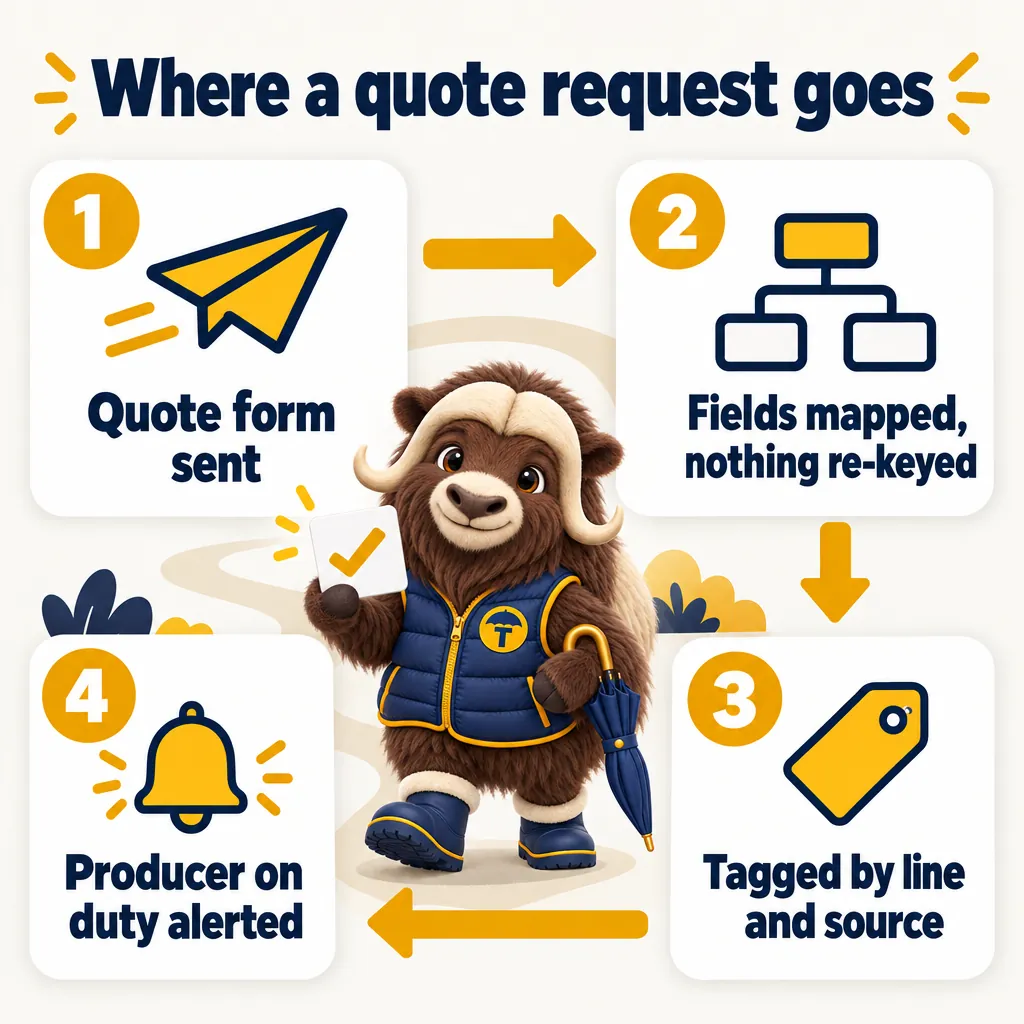
Field mapping, tags by line and source, instant email and SMS to the producer on duty.
- Single Line
- Multi-Line
- Agency Book
Which systems we connect to
We connect to the management system or CRM your agency already runs: EZLynx, HawkSoft, AMS360, Applied Epic, HubSpot and GoHighLevel are the ones we see most, and any system with an API, a Zapier connector or a Make connector works the same way. You do not change systems to work with us. During onboarding we ask which one you use, who has admin access, and where a new prospect should land, and we build the connection before launch. If the agency runs on a spreadsheet for now, the request can go to a shared inbox and a Google Sheet until you pick a system, and we move it over when you do.
How fields are mapped so nothing is re-keyed
Each quote form field is mapped to a named field in your system, so a producer opens the record and sees drivers, vehicles, addresses and coverage interest already in the right places. The line of business and the page the request came from are written as tags, which lets you report on which lines and which towns the site is actually producing. If your system has custom fields for a carrier's intake, we map to those too. You approve the mapping on a test submission before launch. When you add a field to a form later, we add it to the mapping in the same revision.
Who gets told, and how fast
The producer on duty gets an email and a text the moment a request is submitted, with the full submission in the message so they can dial back without logging in. You choose the routing: one person, a round robin by line, or personal lines to one desk and commercial to another. Out-of-hours requests can go to a different producer or wait for the morning, whichever you prefer. The visitor gets an immediate confirmation that names your agency and says who will call and when. Speed of first contact is the single biggest thing an agency controls once the request is in, and this makes it a habit rather than a hope.
Want to see these on a site built for your agency? A demo takes half an hour and happens on your screen.
Book a demoWeekly updates and 5 revisions a month
5 revisions a month included, then $20 each, turned around in 2 to 5 working days.
- Single Line
- Multi-Line
- Agency Book
What a revision is, and what usually gets changed
A revision is any change request you send us, with no limit on how much goes into it. 5 revisions a month are included on every plan, and after that each additional one is a flat $20, with no hourly billing anywhere. The requests we see most from agencies are practical: a new producer joins and needs a bio and a photo, a carrier appointment changes and the carrier page needs to follow, office hours shift for a holiday, a new line is added and needs its page and form. You send the change by email in your own words. You never log in to anything, and nobody at the agency needs to learn a page builder.
How quickly a change goes live
Every revision is completed within 2 to 5 working days of receiving everything we need from you, and small ones are usually live sooner. We confirm the request the same working day, tell you if anything is missing, and send you the link when it is published. Changes that affect a claim of fact about your agency, such as a license number, a carrier list or a service area, are read back to you before they go live so nothing wrong is published. Beyond your requests, we make our own weekly pass over the site for broken links, outdated numbers and search improvements, and note those in a short monthly summary.
Researched articles every week
2 researched articles a week, 3 on the top plan, 2,500 to 3,200 words each, with cited sources.
- Single Line
- Multi-Line
- Agency Book
What we publish and how often
We publish 2 researched articles a week on the first two plans and 3 a week on the top plan, each 2,500 to 3,200 words, under the name of one of your producers or the agency. Topics come from what people in your area actually search before they ask for a quote: what a BOP covers for a landscaping business, how umbrella coverage sits over auto and home, what to gather before a Medicare supplement conversation. Each article carries a table of contents, cited sources, a short FAQ and a link to the quote form for the line it discusses. You approve the topic list at the start and can swap any topic with a note.
Why the articles are general information and never advice
Every article is written as general information for readers and never as coverage advice for a specific person, because that advice is yours to give as a licensed producer and ours to stay away from. The writing describes how a type of coverage generally works, what commonly goes wrong, and what a producer will want to know, and it always points the reader back to a conversation with your agency. We do not state rates, do not promise eligibility and do not compare carriers by price. Every figure in an article is tied to a named source you can check, and the article says so where the subject calls for it.
Managed Cloudflare hosting with nothing itemized
Domain, SSL, backups, uptime and security headers, all inside the monthly fee.
- Single Line
- Multi-Line
- Agency Book
What is inside the monthly fee
Hosting on Cloudflare, an SSL certificate, daily backups, uptime monitoring, security headers and the domain itself are all inside the monthly fee, and none of it appears as a line item. We register a domain for you at no charge, in your name, or point the one you already own. There is no separate hosting invoice, no renewal surprise in eleven months and no upsell for a "pro" tier of the same thing. If the agency cancels, the domain stays yours and we hand over an export of your content within the notice period. The site is a fixed cost you can put in a budget and forget.
Why there are no plugin updates to worry about
There is nothing on the site for you to update, because the site is static HTML with no plugins, no theme and no database to patch. That removes the most common reason an agency site goes down or gets defaced: a plugin nobody updated since the site was built. Security headers are set at the edge, the certificate renews itself, and backups are taken on every change so a bad revision can be rolled back in minutes. If Cloudflare has an incident, we tell you what happened and what we did. Nobody at your office is ever asked to log in and click "update now".
The AI Engine
AI receptionist, site chat and SMS, Messenger and Instagram agents that take quote details and book calls.
- Single Line
- Multi-Line
- Agency Book
What the AI receptionist does on the phone
The AI receptionist answers the agency line when nobody can, takes the caller's name, the line they are calling about and the details a producer needs to start, and books a callback on a producer's calendar. It answers plain questions about hours, location, which lines you write and how claims are reported. It is available on the Multi-Line and Agency Book plans, and text messaging requires A2P 10DLC carrier registration, which we file for you. After each call you receive a short call-analysis PDF: who called, what they wanted, what was captured and what the next step is, so nothing said on the phone is lost between the call and the quote.
Site chat and messaging on SMS, Messenger and Instagram
The same agent runs the chat window on the site and replies on SMS, Facebook Messenger and Instagram, so a prospect who starts on a social post ends up in the same quote queue as one who filled in a form. It asks the same questions as the matching quote form, in conversation, and writes the answers into your CRM or AMS with the source tagged. Conversations are handed to a producer as soon as the prospect asks for one or the agent reaches the edge of what it is allowed to say. Every transcript is kept against the contact record, so the producer picks up where the conversation left off.
What the agents are configured never to do
The agents are configured never to quote coverage, state a rate, say whether someone qualifies or recommend what to buy, and to hand anything that would amount to advice straight to a licensed producer. They describe the agency, capture details and book conversations. That boundary is written into the scripts, which you review and approve before launch, and it is tested with the questions a prospect actually asks. If a caller asks whether their roof is covered, the agent says a producer will answer that and books the call. You remain responsible for the consent, opt-out and record-keeping rules that apply to your own client communications; we set the agents up to make that easy.
The Content Engine
3 articles a week, 3 social image posts a week, 2 reels a week and a managed Google Business Profile.
- Single Line
- Multi-Line
- Agency Book
What the Content Engine adds on the Agency Book plan
The Agency Book plan raises the article count to 3 a week and adds 3 social image posts and 2 short reels a week, all drawn from the same topic list so the site, the feed and the map listing say the same thing. The social posts are built for Facebook, Instagram and LinkedIn in your colors, and each one links to the article or the quote form it was made for. Reels are short, captioned and written to be read with the sound off. You see everything in a shared folder before it is published and can pull anything with a note. Nothing goes out that mentions a rate, a carrier comparison or an eligibility promise.
A Google Business Profile that stays alive
We manage your Google Business Profile as part of the plan: weekly posts, photo updates, hours and holiday changes, service lists that match the lines on your site, and answers to the questions people leave there. A profile that has not been touched in months tells the map it is not worth showing. We also draft replies to reviews for you to approve, in your voice, and never post one without your say-so. The profile links back to the matching line and location pages, so a search that starts on the map ends on the page with the quote form. It is the part of local search that is easiest to forget, and it is now somebody's job.
Speed and ad cost
How page speed helps the ads you already run
A fast, relevant landing page can lower what you pay per click and keeps more of the visitors you already paid for. Google Ads Quality Score includes landing page experience, meaning how relevant and useful the page is to the person who clicked.
Each line page is a ready-made landing page for a line-specific ad, with its own form, and every page is built for 90+ PageSpeed. We do not promise a specific cost-per-click change; we give your ads a page that loads fast and answers the ad.
Sources: Google Ads Help, "About Quality Score for Search campaigns" (landing page experience is one of three components), checked September 18, 2026; Google Ads Help, "Evaluate the performance of your landing pages" (mobile page speed and ad results), checked September 18, 2026
- 01
Fewer paid clicks lost to a slow page
Visitors see the form before they give up.
- 02
A relevant page for every line you advertise
An auto ad lands on the auto page, not the home page.
- 03
Nothing heavy added behind your back
We tell you the speed cost before adding any third-party widget.
SEO, AEO, GEO and schema, as features you get
Being found by search engines, being the answer that gets quoted, and being cited by AI assistants. All on every plan.
Technical and on-page SEO
Clean URLs, one H1 per page, unique titles and descriptions, internal links between line, town and carrier pages, a sitemap and 301s for anything that moves.
Location pages that grow local traffic
A page for each town and county you serve, crossed with the lines you write there. Local searches are specific ("renters insurance in" a town); a page that answers exactly that search is the one that ranks and gets the request.
AEO: answers that get lifted
Answer-first sections and marked-up FAQ blocks so featured snippets, voice answers and AI answers can quote your page.
GEO: easier for AI assistants to cite
llms.txt, consistent names for the agency and every service, dated pages and plain facts, so ChatGPT, Claude, Perplexity and Google AI Overviews can understand you. We make a mention more likely; nobody can promise one.
Schema on every page
Organization or LocalBusiness, Service, FAQPage, BreadcrumbList and BlogPosting JSON-LD. Review markup only for real reviews you collect.
Fresh, cited content
2 to 3 researched articles a week, each 2,500 to 3,200 words, with sources a reader can check.
Compliance pages and wording that come with the site
Built with US rules in mind to help you meet them. Not legal advice; you approve the final wording.
Privacy policy
Written for your agency, with state privacy laws such as the California Consumer Privacy Act in mind.
Cookie consent that really gates scripts
Analytics and ad tags stay off until the visitor agrees.
Accessibility statement and build
Built with the ADA and WCAG 2.1 AA in mind: headings, labels, keyboard use, contrast and reduced motion.
Your disclaimer and license wording
The wording you supply for your states on every page, read back before launch.
TCPA-minded SMS consent
Consent and opt-out wording on forms that lead to text messages, plus A2P 10DLC filed on the AI plans.
Medicare and benefits wording
General plan language written with CMS Medicare marketing guidelines in mind, for agencies that write them.
Weighing it up
How these features compare with other options
- GoHighLevel funnels vs a managed site
Funnels are great for one campaign; the website is where every line, town and carrier lives. Many agencies use both.
- GoHighLevel website builder vs a managed site
A HighLevel site keeps everything in one account; a managed site takes the build, the search work and the upkeep off your desk.
- GoHighLevel AI Studio vs a managed site
AI Studio drafts pages from a prompt inside HighLevel; a managed site adds the planning, compliance care, search work and weekly upkeep.
- WordPress vs a managed site
WordPress can do almost anything if someone maintains it; a managed site removes plugins, updates and hosting from your list.
Questions about the features
What does the AI Engine actually do for an agency?
It answers the phone, the site chat and your text, Messenger and Instagram messages when a producer cannot. It takes the caller's name, line of business, current carrier and renewal date, books a call with the right producer and sends you a call analysis PDF afterwards. It never quotes coverage, rates or eligibility. Anything that sounds like advice is handed to a licensed person at the agency. It is included on Multi-Line and Agency Book, with usage billed monthly at cost.
Will the AI receptionist say something a licensed producer would not?
No. The agents are scripted around what you approve and are configured not to give coverage, rate or eligibility answers. If a caller asks whether a policy covers something, the agent says a licensed producer will confirm and books the call. You review the scripts before launch and can change them with a revision. Every conversation is logged so a producer can read exactly what was said before calling back.
Do I need anything registered before the AI can text customers?
Yes, A2P 10DLC registration, and we file it for you. Carriers require every business that sends texts through an application to register its brand and campaign. We complete the filing during the build, using the agency's legal name and EIN, and pass the carrier fee through at cost. Until it is approved, the AI Engine works on the phone, site chat, Messenger and Instagram, and SMS switches on the day the registration clears.
How is AI usage billed on Multi-Line and Agency Book?
Monthly in arrears, at cost, on the same invoice as the plan. Usage is the phone minutes, messages and text volume the AI Engine actually handles, plus the A2P 10DLC carrier fee passed through once at registration. The plan fee of $267 or $647 is billed in advance as normal. You see usage broken out every month, and if you want a cap we set one so the agents stop before it is passed.
Why does page speed matter so much for an insurance agency?
Because most quote shopping starts on a phone, often somewhere with a weak signal. A page that takes too long to draw is a closed tab, and the quote form at the bottom is never seen. Our pages are static HTML with almost no script, served from Cloudflare's edge, and every page we build and host is held to 90+ PageSpeed. If a page we control drops below it, we fix it at no charge.
What SEO do you do on an agency website?
Technical and on-page SEO on every page, plus the structure that ranks. That means clean URLs, one clear heading per page, unique titles and descriptions, internal links between line, town and carrier pages, an XML sitemap and correct redirects, a page for every line you write and a location page for every town and county you serve, and 2 or more researched articles a week. Rankings take time; the pricing terms give 3 to 5 months as the usual window to start ranking for local searches.
What structured data (schema) do you add?
JSON-LD for the agency as an Organization or LocalBusiness, each line of business as a Service, each FAQ block as an FAQPage, breadcrumbs on every inner page, and each article as a BlogPosting with its author. Review markup is added only for real reviews you have collected, never for sample text. Structured data helps search engines and AI assistants read who you are, where you work and what you offer.
Is the website built for accessibility?
Yes. Sites are built with the ADA and WCAG 2.1 AA in mind: real headings, labelled form fields, keyboard navigation, visible focus, readable contrast in light and dark, and motion that respects reduced-motion settings. Every site carries an accessibility statement with a way to report a problem. We do not claim any site is certified compliant; we build to the standard and fix what is reported.
What does "fully managed" mean day to day?
It means nobody at the agency logs into anything. We keep the site fast at 90+ PageSpeed, apply security updates, monitor uptime, fix anything that breaks, make the weekly updates, complete your revisions, publish the articles and watch how the quote forms perform. You get a monthly email with what changed and what came in. If a producer notices something wrong on a Sunday, they email us and it is handled.
How many articles a week, and who checks them?
Single Line and Multi-Line get 2 researched articles a week. Agency Book gets 3. We draft them, check every figure against a cited source, and send you a short summary before they publish. You or a producer can ask for changes or veto any article. Articles carry a general information disclaimer and are never attributed to a licensed producer at the agency unless that producer has written or approved the piece.
Every feature, on a site built for your lines.
A live walk-through on your screen of the site you would get: your lines, your towns, your quote forms. Plans $127 a month, the $697 build fee invoiced only after launch, live in 7 days.