Personal lines pages
Auto, home, renters and umbrella, written for households comparing quotes fast.
Pick the book you write. Each page shows the pages, the quote form and the plan that fit it.
See all agency typesProperty and casualty
What the site carries and what we keep running for you, with the plan each one sits on.
See all featuresWhere quotes start
Design and build
Search, redesign and scale
Reading, answers and the people who write them.
Plans $127 a monthLive in 7 days$697 build fee, invoiced after launchDomain and hosting included
Design and build
Search, redesign and scale
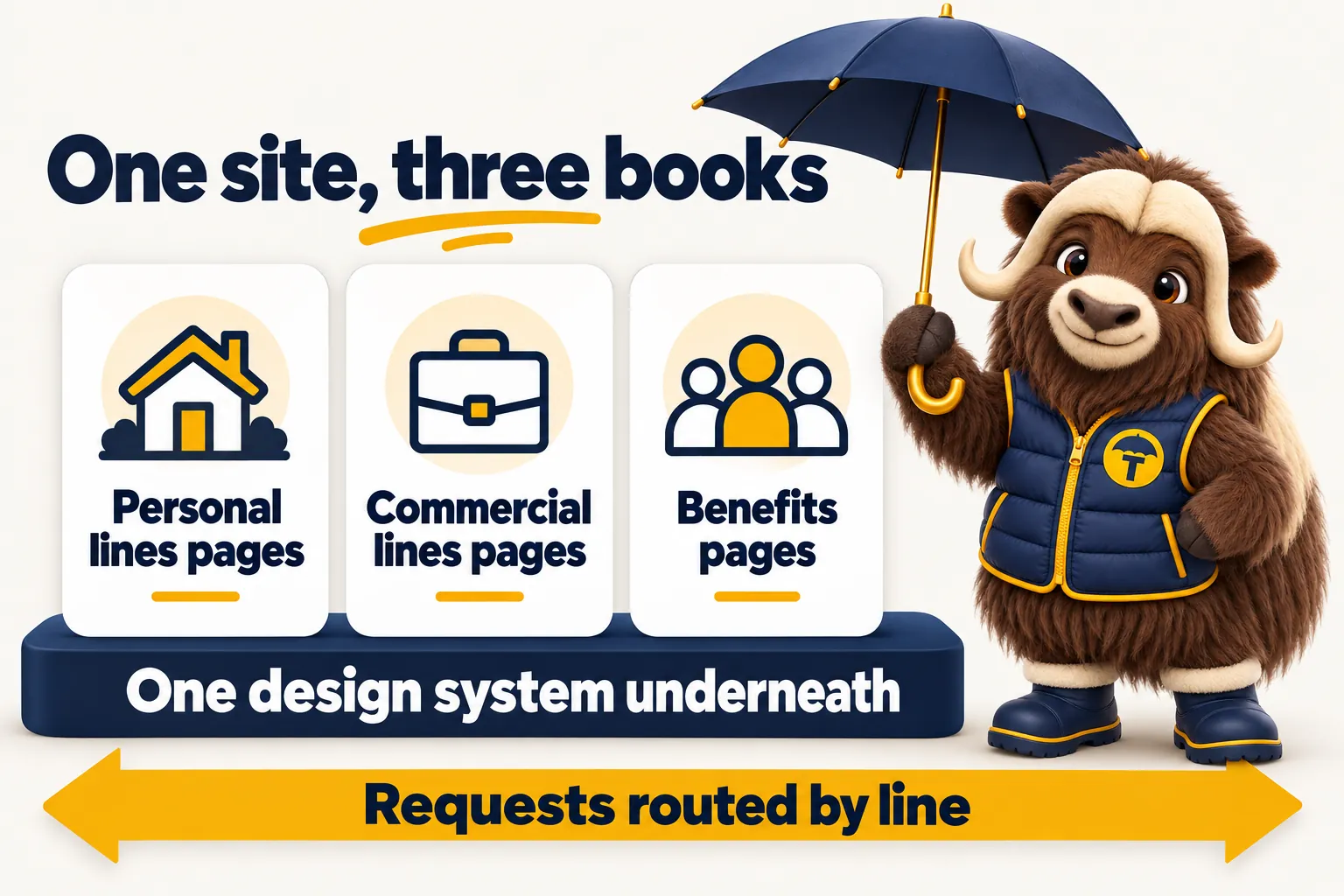
The right website design for an insurance agency depends on what the agency actually writes: a personal lines shop selling auto and home to households needs a different homepage logic than a commercial lines agency writing BOPs and workers comp for contractors, and a benefits broker selling group plans to employers needs a different one again. The same design system, applied with a different emphasis for each kind of book, is what makes the site feel built for you rather than for insurance agencies in general.
What it costs
Who it is for
Agencies with a mixed book, personal lines, commercial lines and benefits, that need each audience to land on pages written for them under one brand.
If two or more of the signs on this page sound familiar, this is the page for you.
Households and business owners land on the same generic coverage page.
Your benefits clients are offered an instant quote form that cannot quote group coverage.
Commercial prospects cannot tell whether you write their class of business.
Adding a new line means a redesign conversation with a developer.
A personal lines agency's visitor is usually comparing two or three quotes for auto or home and deciding fast, often on a phone between other tasks, standing in a parking lot or scrolling during a lunch break. The design leans on short, specific forms per line, plain language over insurance jargon, and a homepage that gets to "get a quote" within one scroll rather than making them hunt through a menu. Bundling auto and home is called out where it applies, since a household weighing separate quotes benefits from seeing that option early rather than discovering it in a phone call after they have already filled in two separate forms and started comparing numbers on their own.
A contractor writing a BOP wants to see a page that mentions contractors, not a generic "business insurance" page that could belong to any agency in any state. Website design for a commercial lines book leans on named industries, a slightly longer form because commercial risks need more detail to route to the right producer, and copy that shows the agency understands the class of business rather than just selling coverage at a general level. A restaurant owner and a landscaping company owner should land on pages that read differently, use different examples, and ask different questions, even if both eventually reach a broadly similar BOP form underneath.
Group benefits are sold to an employer over weeks, not in one form submission, so the design supports a slower decision rather than pushing for an instant conversion the way a personal lines page can. That means examples of the kinds of groups already served, a clearer explanation of what open enrollment support actually looks like month to month, and a "request a proposal" form in place of an instant quote button, since benefits pricing depends on census data a form cannot capture upfront. The page also speaks to whoever is actually deciding, often an HR manager or owner comparing several brokers, so the copy leans on service and responsiveness as much as on the plans themselves.
Every book still gets the same underlying system: one type scale, one accent colour, the same PageSpeed guarantee, and the same hosting and CRM or AMS integration standard on every plan. What changes across personal, commercial and benefits is which pages get built first, how long the forms run, and which words appear in the headlines and page copy for each audience. A mixed agency writing personal, commercial and benefits business gets all three treatments applied to the pages that actually need them, so a homeowner, a contractor and an HR manager each land on a page that clearly reads as built for their situation, all under one coherent brand.
Everything below ships on every plan, alongside hosting, a free domain, weekly updates and researched articles.
Auto, home, renters and umbrella, written for households comparing quotes fast.
BOP, general liability and workers comp, written by industry where it helps.
Group plans framed as a proposal request, not an instant quote form.
Same type scale, colour and radius, applied with a different emphasis per book.
Personal, commercial and benefits leads tagged and sent to the right producer.
2 researched articles a week, on the topics your actual clients search.
I tested the personal coverage inquiries page on my own phone before we approved anything. The essentials are within the first screen, with an obvious way to inquire. It is far more practical than the old page when we share it with a caller.
The preparation page for personal coverage inquiries works because it keeps its focus. It explains what the first conversation needs, and deliberately asks for nothing sensitive online. First conversations are shorter and better because of it.
Four steps, and you pay for the build only after you have seen it live.
Every visitor ready to shop leaves through a phone number, or leaves nothing at all.
Pick a plan on the pricing page. The first month is the only thing you pay before the site exists.
We do not yet know your lines, your carriers, your towns or the system your producers work in.
Lines you write, carriers you are appointed with, towns you serve, producers, and which CRM or AMS the requests go into. Anything missing can follow later by email or as a portal ticket.
Not one line you write and not one town you serve has a page of its own.
Pages, quote forms, integrations, articles queued. You review a live link and send changes as revisions.
The build is not paid for, and you have not seen the site it paid for.
Once the site is live and you have approved it, we invoice the $697 one-time build fee. Not before.
See website design for insurance agencies applied to your own agency on a half-hour demo. Plans $127 a month.
Book the demo$127, $267 or $647 a month
Single Line, Multi-Line, Agency Book. The plan, not the page count, sets the price.
$697 build fee, after launch
Invoiced once the site is live and you have approved it. Never up front.
Live in 7, 10 or 15 days
By plan, counted from the onboarding call, once we have your lines, carriers and towns.
What moves the price
Only the plan you choose, AI usage at cost on the AI plans, and revisions beyond 5 a month.
Plain about the edges, so nothing surprises you later.
See it live before the build fee
You approve the live site first.
90+ PageSpeed, or we fix it
On every page we build and host, at no charge.
No contract term
Cancel with 2 business days notice before your next invoice; keep your domain and content.
Built with US rules in mind to help you meet them; you approve the final wording.
Client builds where this work did the heavy lifting, each with the timeline and the outcome.
Case file 02
When somebody rings about personal coverage inquiries, I send one link and tell them exactly where to tap. The guided tour of our menu is no longer part of the call.
Day to day with personal coverage inquiries, one link replaces the patchwork of emails.
With personal coverage inquiries, the site now argues with evidence the business chose to publish.
Yes, and it is built to. The homepage separates the two from the top level, personal lines gets its short-form treatment and commercial lines gets its industry-led treatment, and each line page is written and formed for what that line actually needs to start a quote.
Yes. Benefits and group plan pages are built around a proposal request form that collects group size, industry and current plan status rather than pretending to quote coverage instantly, which better matches how group benefits are actually priced.
Yes, and it is a revision rather than a new project. Tell us the class, we build the page with the right emphasis for that kind of buyer, and it is live within 2 to 5 working days as one of your 5 monthly revisions.
No. Plans start at $127 a month regardless of how many kinds of business you write, with a $697 build fee invoiced only after launch.
They share one navigation, split clearly into personal and business sections from the top level, so each visitor finds their line in one decision.
Yes, where it helps. A contractor, a restaurant and a landscaping company can each have a page that reads differently and asks the questions that class needs, written in general terms.
Proposal requests are tagged as benefits and routed to the producer or desk you choose in your CRM or AMS, separate from personal lines requests.
Any plan carries every line. Agencies with a large commercial book often choose Agency Book for the extra article volume (3 a week) that helps each line rank.
A live walk-through of the site you would get, in about 30 minutes. Plans from $127 a month, the $697 build fee invoiced only after launch, domain and hosting included.
Book a demoOr email and a person replies within one working day.
GetInsuranceWebsite uses the cookies below. Necessary cookies keep the site working and cannot be turned off.
Saved on this device only. Press Esc to close.