Line-by-town page matrix
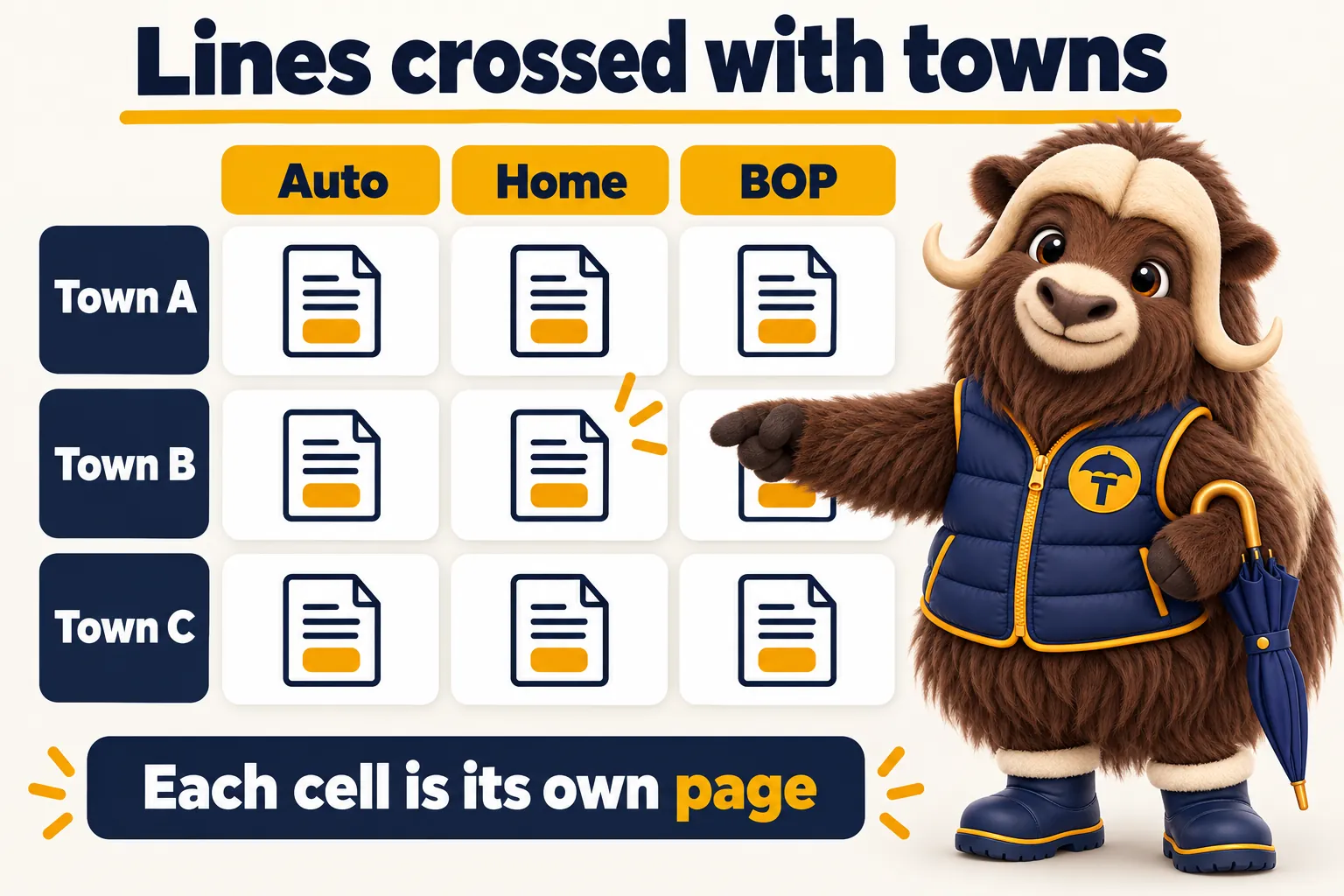
Every line you write, crossed with every town you serve, each its own page.
Pick the book you write. Each page shows the pages, the quote form and the plan that fit it.
See all agency typesProperty and casualty
What the site carries and what we keep running for you, with the plan each one sits on.
See all featuresWhere quotes start
Design and build
Search, redesign and scale
Reading, answers and the people who write them.
Plans $127 a monthLive in 7 days$697 build fee, invoiced after launchDomain and hosting included
Design and build
Search, redesign and scale
SEO for an insurance agency site is mostly an information architecture problem before it is a content problem: if there is no page dedicated to homeowners insurance in a specific town, there is nothing for that search to rank on no matter how well the rest of the site is optimized. Insurance SEO web design starts by crossing every line you write with every town you serve, then structures and writes each resulting page to actually answer the search rather than just contain the keyword somewhere on the page.
What it costs
A page for "homeowners insurance" and a separate page for "insurance in Round Rock" are both weaker than a single page for "homeowners insurance in Round Rock," because that combined phrase is closer to what someone actually types when they are ready to buy rather than just researching. We build the page set as a matrix, every line you write against every town you serve where it makes sense, rather than picking one axis and hoping it happens to cover the other well enough to compete with agencies that built the full grid on purpose.
Each page opens with a direct answer to its likely search intent, followed by the specifics a shopper needs, coverage basics for that line, common questions specific to that town or state, and a quote form near the top rather than buried at the bottom. Headings follow a logical hierarchy, and schema marks up the agency as an organization, each line as a service and each FAQ as a structured question and answer, so search engines and AI answer engines alike have a clean structure to read rather than having to infer it from loosely organized paragraphs written for humans alone.
Line and town pages get you found; ongoing content keeps you visible over time as competitors publish their own material. 2 researched articles a week on the first two plans, 3 on Agency Book, cover the questions your prospects search before they ask for a quote, cite their sources, and are written as general information rather than coverage advice, which keeps the agency clear of implying it is giving advice it should not be giving on a public website. Each article links back to the relevant line or town page, adding internal links a search engine can follow.
SEO advice that ignores technical basics is incomplete: a page that answers the search perfectly but takes six seconds to load loses the visitor before they read a word of it, and search engines increasingly factor that experience into ranking too. Every page we build and host is guaranteed at 90+ PageSpeed, served from Cloudflare's edge, which removes speed as a reason a well-structured, well-written page fails to rank or convert once it finally does show up in results. Clean URLs, a working sitemap and correct canonical tags round out the technical side nobody sees but every crawler relies on.
We guarantee the site starts ranking for local insurance searches in your area within 3 to 5 months of launch. If it has not, we keep doing the search work, more pages, more content, technical fixes, at no additional charge until it does, rather than treating the guarantee as covering only the initial build and leaving you to figure out the rest on your own once the invoice is settled. That means the incentive stays lined up after launch: a page set that stops ranking is our problem to fix, not a support ticket you have to raise and pay for separately once the honeymoon period on the contract has ended.
Across the US
We build for agencies in every state, including Texas, Florida, California, Georgia, North Carolina, Ohio, Pennsylvania and Illinois. Each location page and article is written for its own market: wind and flood questions on the Gulf and Atlantic coasts, hail in Texas, wildfire in California, winter driving in Ohio and Pennsylvania.
Who it is for
Agencies that want to be found for the lines they write in the towns and counties they serve, and increasingly in answer boxes and AI assistants too.
If two or more of the signs on this page sound familiar, this is the page for you.
You rank for your agency name and nothing else.
Comparison sites outrank you for coverage searches in your own town.
Your site has one page for all lines and no location pages.
You have no idea whether AI assistants know your agency exists.
Everything below ships on every plan, alongside hosting, a free domain, weekly updates and researched articles.
Every line you write, crossed with every town you serve, each its own page.
Organization, service and FAQ schema on every relevant page.
2 to 3 a week depending on plan, cited and general-information only.
Removes load time as a reason a well-optimized page underperforms.
Structured for local search, not a single generic service area page.
If it has not started ranking, we keep working at no extra charge.
See insurance seo web design applied to your own agency on a half-hour demo. Plans $127 a month.
Book the demoThe reporting for personal coverage inquiries is something I can genuinely use. The report separates genuine inquiries from raw traffic and leaves message content out of it. It gives us a better question to ask of every page.
The starting point was our own sent mail, not a template, and it shows. Nothing went live until the person responsible for that subject had signed off the answer. The phone calls about basic personal coverage inquiries details have noticeably thinned out.
Four steps, and you pay for the build only after you have seen it live.
Every visitor ready to shop leaves through a phone number, or leaves nothing at all.
Pick a plan on the pricing page. The first month is the only thing you pay before the site exists.
We do not yet know your lines, your carriers, your towns or the system your producers work in.
Lines you write, carriers you are appointed with, towns you serve, producers, and which CRM or AMS the requests go into. Anything missing can follow later by email or as a portal ticket.
Not one line you write and not one town you serve has a page of its own.
Pages, quote forms, integrations, articles queued. You review a live link and send changes as revisions.
The build is not paid for, and you have not seen the site it paid for.
Once the site is live and you have approved it, we invoice the $697 one-time build fee. Not before.
$127, $267 or $647 a month
Single Line, Multi-Line, Agency Book. The plan, not the page count, sets the price.
$697 build fee, after launch
Invoiced once the site is live and you have approved it. Never up front.
Live in 7, 10 or 15 days
By plan, counted from the onboarding call, once we have your lines, carriers and towns.
What moves the price
Only the plan you choose, AI usage at cost on the AI plans, and revisions beyond 5 a month.
Built with US rules in mind to help you meet them; you approve the final wording.
Plain about the edges, so nothing surprises you later.
See it live before the build fee
You approve the live site first.
90+ PageSpeed, or we fix it
On every page we build and host, at no charge.
No contract term
Cancel with 2 business days notice before your next invoice; keep your domain and content.
Client builds where this work did the heavy lifting, each with the timeline and the outcome.
Case file 03
The starting point was our own inbox, not a template. The personal coverage inquiries page sounds like us on a good day, with the contradictions ironed out.
With personal coverage inquiries, staff reply with a precise link instead of an attachment.
Day to day with personal coverage inquiries, the business maintains key information in one place and has a practical method for checking related pages.
Generic SEO advice does not account for the fact that insurance search intent is usually line-plus-location: someone searches for a specific coverage in a specific place. Insurance SEO web design builds the site's actual page structure, a page per line crossed with a page per town, around that pattern rather than applying generic keyword advice to a one-size-fits-all page set.
No. Each page is written to actually answer the question a searcher has for that line and town, with the keyword appearing naturally because the page is genuinely about that topic. Search engines penalize stuffing, and it reads badly to a real visitor anyway.
We guarantee the site starts ranking for local insurance searches within 3 to 5 months of launch. Some pages, especially for less competitive towns or lines, rank sooner; more competitive metro areas can take longer, which is why we keep working past the guarantee window at no extra charge if needed.
Yes, the same crossing logic applies at a smaller scale: your one or two lines crossed with every town you serve, rather than needing a large book to benefit from the structure.
People search for coverage with a place in the query, such as homeowners insurance in a town. A page written for that town and that line is the page search engines can match to the search, and it carries the form to start the quote. We write each location page for the real place, never a template with the name swapped.
SEO is being found and ranked. AEO, answer engine optimization, is being the answer that gets quoted in a featured snippet, voice result or answer panel. It comes from answer-first sections and marked-up FAQ blocks, which we build into every line and town page.
We publish an llms.txt file, keep your agency and service names consistent, date every page and state facts plainly, so assistants can understand and cite the site. Nobody can guarantee a mention; this makes it more likely.
Yes. Location pages, license wording and articles are written for each state you work in, whether that is Texas and Oklahoma or Florida, Georgia and the Carolinas.
A live walk-through of the site you would get, in about 30 minutes. Plans from $127 a month, the $697 build fee invoiced only after launch, domain and hosting included.
Book a demoOr email and a person replies within one working day.
GetInsuranceWebsite uses the cookies below. Necessary cookies keep the site working and cannot be turned off.
Saved on this device only. Press Esc to close.