Medicare, life and benefits pages: what an agency website can and cannot say
How to write Medicare, life, health and benefits pages on an agency site: general plan wording, phrases to avoid, disclaimers, TPMO notes and forms without PHI.
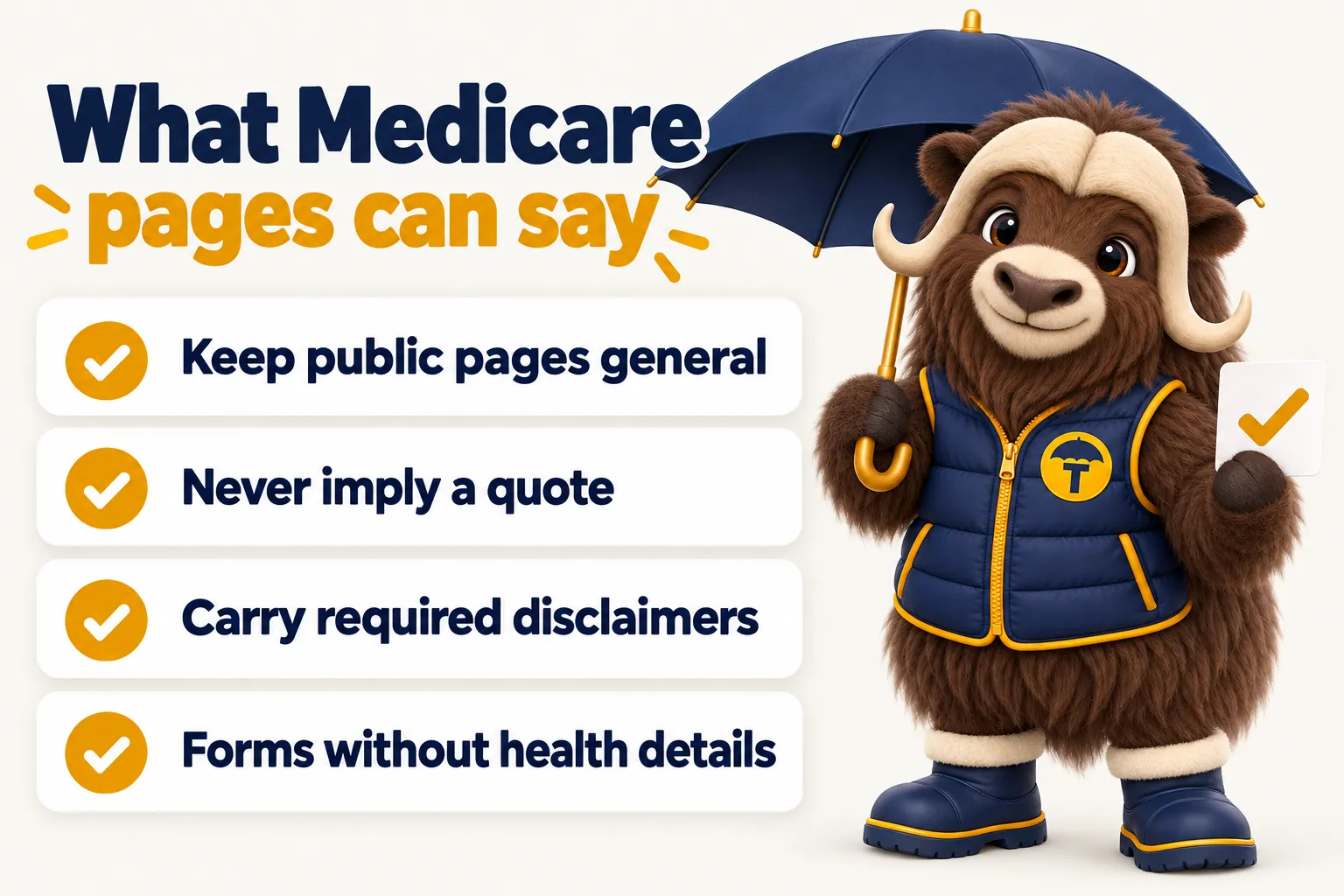
A Medicare, life, health or group benefits page on an agency website can explain the line of business in general terms, say what the agency does and how to reach a licensed agent, and carry the disclaimers the agency is required to display. It should not describe a specific plan’s benefits or costs on a public page without approval, should not use words that imply the site has quoted a rate or decided eligibility, and should not collect anything about a person’s health. Those three limits cover most of the trouble an agency site can get into on these lines.
This article is general information about website copy practice. GetInsuranceWebsite is a website design and management company. We are not an insurance agency, broker, carrier or licensed producer, and this is not legal, regulatory or compliance advice. What your pages must say, what they may not say, and what has to be reviewed or filed before it is published depend on your contracts, your appointments, your state and the current federal rules. Confirm every point below with your carrier, your upline and your own compliance counsel before you publish.
Who decides what these pages may say
Your carrier, your upline or field marketing organisation, and your own compliance counsel decide, and the website implements that decision. This ordering matters because agency websites go wrong in a predictable way: somebody copies wording from another agency’s site, assumes that its presence on the internet means it was approved, and publishes it. Wording that was approved for one agency’s contracts, states and appointments is not automatically permissible for yours, and wording that was correct two years ago may no longer match the current rules.
There is a second reason the ordering matters. The federal rules for Medicare Advantage and Part D communications and marketing are updated regularly, and the current text lives in the Code of Federal Regulations rather than in any summary. When you need the actual requirement, read the current regulation or ask the people who are contractually accountable for your materials. Treat every summary, including this one, as a prompt to go and check.
Three approvals before a page goes live
Build the workflow before you build the page. For any Medicare, life, health or group benefits page, the sequence that keeps agencies out of trouble is usually: draft the copy, send it to the carrier or upline for whatever review your contracts require, have your own compliance counsel look at anything the agency is inventing rather than copying from approved material, then publish. Keep a dated record of what was approved and by whom, because a page that has been live for a year will eventually need to be defended or updated, and nobody will remember.
The website’s real job on these lines
The site’s job on Medicare, life, health and benefits is to be found, to explain the line honestly in general terms, to establish that the agency is a real local business with licensed staff, and to make it easy to start a conversation with a licensed agent. It is not a quoting tool, not an enrolment channel and not a plan comparison engine. The pages we build for Medicare agents, life and health agents and benefits brokers are structured around that narrower job on purpose.
Describing plans in general terms
General education about a line of business is what a public page should carry. That means explaining what a category of coverage generally does, what questions a person usually needs to think about, what documents or information tends to come up in the conversation, and how the agency works. It does not mean listing the benefits, premiums, copays, deductibles, networks or star ratings of a particular plan.
The difference the rules draw
The federal framework for Medicare Advantage and Part D distinguishes between broad communications and the subset of them that constitutes marketing, and it attaches extra requirements to material that is intended to draw attention to a plan or influence an enrolment decision, particularly where it mentions plan benefits, cost sharing, premiums, ratings or rewards. That distinction is why a page saying “here is what Medicare Part D generally is and here is how our agency helps” sits in a different place from a page saying “this plan has these benefits for this premium”. The current definitions and the content requirements are in Part 422 Subpart V and Part 423 Subpart V. Read them, and then ask your carrier and upline how they apply the line in practice, because carriers frequently apply a stricter standard than the regulation requires and they are the ones who approve your materials.
How to write the general version well
A general page can still be genuinely useful, and the useful version outranks the thin version. Write what a person actually wonders about: what the parts of Medicare are and how they relate to each other, what happens around the enrolment periods, what kinds of coverage exist to sit alongside them, what somebody should have to hand before a first conversation, what questions the agency will ask, and what the agency will not do. Explain the agency’s own process. Name the states the agency is licensed in. Say who the licensed agents are. None of that requires a plan name, and all of it builds the trust the form depends on.
For life and health lines, the same approach holds. A page can explain in general terms what term life, whole life or an individual health plan is for, what underwriting generally involves as a process, and what the agency does. It should not promise acceptance, describe what a particular applicant will pay, or state that coverage is guaranteed.
For group benefits, a page can explain what an employer typically buys, what the broker does through the year, how renewals generally run, and what a first conversation covers. It should not publish rates, claim savings figures, or describe a particular carrier’s plan design as an offer.
Naming carriers and plans
Naming carriers on a page is common practice for independent agencies, and it still needs permission. Carriers have rules about the use of their names, logos and trade marks, and those rules are in your appointment paperwork and your marketing guidelines. Ask before you publish a logo wall. For Medicare Advantage and Part D specifically, naming a plan and describing it are different acts with different consequences, and a page that names plans is far more likely to be treated as marketing rather than general communication. Confirm with your carrier, your upline and your own compliance counsel.
Do not publish benefit or premium claims on a general page
Claims such as a zero dollar premium, extra benefits, savings, or anything that quantifies what a reader would get belong in approved plan material delivered in the approved channel, not on a public agency page. Even an accurate statement about one plan invites a general reader to treat it as an offer available to them, which is the impression the rules exist to prevent. If your carrier approves specific benefit wording for a specific context, use it exactly as approved and only where approved.
Words that imply a quote, a price or an eligibility decision
Cut every word that suggests the website itself has priced, approved, accepted or enrolled somebody. A marketing website collects a request. A licensed agent, and the carrier behind them, does everything else. The vocabulary on the page has to make that obvious to a reader who is skimming on a phone.
The verbs and phrases to retire
| Do not publish | Publish instead |
|---|---|
| Instant quote, get your rate now | Request a call from a licensed agent |
| See your price | Ask us a question about your options |
| You qualify, check your eligibility | Talk to a licensed agent about your situation |
| Guaranteed acceptance, guaranteed approval | Learn how the process generally works |
| Enroll now, sign up here (on a page that only collects a contact request) | Request an appointment with a licensed agent |
| Free plan, no cost coverage | A general description of the line of business |
| We offer every plan, all plans in your area | Carry the required disclaimer about the plans the agency does offer |
| The best plan for you, our top rated plan | Explain how the agency helps you compare your own options |
| Approved in minutes | Explain what the first conversation covers |
| Act now, offer ends soon | Reference a real published enrolment period, factually and without pressure |
Superlatives, rankings and unsubstantiated claims
Superlatives need substantiation, and most agency sites cannot substantiate the ones they use. Best, top rated, number one, most trusted and lowest cost are all claims. The Federal Trade Commission’s business guidance on advertising is the general framework for truthful and substantiated advertising claims, and it applies to an insurance agency’s website like any other business. Beyond the general standard, carriers and uplines usually forbid comparative and superlative claims about plans outright. If a claim cannot be backed with something you could show somebody, take it off the page.
Urgency
Real enrolment periods exist and can be described factually. Manufactured urgency cannot. A countdown timer, a limited spots message or a deadline that moves every week are the kinds of pressure tactics that draw regulatory attention on these lines specifically, and they are also a poor fit for an audience deciding on something this important. State the period, state what it means in general terms, point people to the official source, and let the agency’s usefulness do the persuading.
Testimonials and results
Testimonials on Medicare, life and health pages need care. A quote from a client that describes what they got, what they saved or that they were accepted is a performance claim wearing a friendly face. Testimonials about the agency’s service, responsiveness and clarity are safer ground, and they still need to be genuine, attributable and used with permission. Ask your carrier, your upline and your own compliance counsel what they permit before publishing any of them.
Avoid anything that looks governmental
Do not use design, colour, seals, wording or imagery that could lead a reader to think the site is operated by, endorsed by or connected with a government programme. That includes official looking seals, wording such as official enrolment centre, and domain names or page titles that imply a government connection. Many agencies carry an explicit statement that they are not connected with or endorsed by the federal government or the Medicare programme. Ask your carrier and your upline what statement they require and where it must appear.
Disclaimers agencies commonly carry
Most Medicare pages carry at least two disclaimers, and the exact text is set by the current regulation and by what the carrier or upline supplies rather than by the agency’s own drafting. Never write these from scratch and never copy them from another agency’s website.
The third party marketing organisation disclaimer
The disclaimer most commonly seen on agency Medicare pages states that the agency does not offer every plan available in the area, that any information it provides is limited to the plans it does offer, and directs the reader to contact Medicare.gov or 1-800-MEDICARE to get information on all of their options. The requirement, the exact wording, who must display it and where it must appear are set out in the federal rules for agents, brokers and other third parties, and they are updated from time to time. Copy the current text from the current regulation or from the material your carrier or upline provides, and check it again each plan year with your carrier, your upline and your own compliance counsel.
The non-government statement
A statement that the agency is not connected with or endorsed by the federal government or the Medicare programme is widely used. Again, the required wording and placement come from your carrier or upline and the current rules, not from your web designer.
Life, health and benefits disclaimers
For life and health pages, agencies commonly carry a statement that the page is general information and not a policy, that coverage is subject to underwriting and to the terms of the policy issued, that products and availability vary by state, and that the agency is licensed in named states. For group benefits, a statement that the content is general information and not legal, tax or employee benefits advice is common, since benefits conversations touch areas where an employer needs its own advisers. Your own compliance counsel should tell you which of these you need and how they should read.
Licence numbers and state disclosure
Many states require a producer or agency licence number to appear on advertising, and the requirements differ state by state. If the agency writes in several states, the site needs a clear way to show which licences apply where. That is a structural decision as much as a copy decision, and it is one reason we build a per-producer page pattern on producer focused sites. Ask your own compliance counsel what your states require.
Where disclaimers belong on the page
Put required disclaimers where they will be read on a phone, not only in a footer at the end of a long scroll. Near the form, near the call to action and in the footer is a common pattern. Keep the text legible: full size body text or close to it, real contrast, and no collapsing it behind a toggle if it is required to be conspicuous. A disclaimer set in pale grey at a tiny size is a disclaimer that somebody will argue was not displayed.
Third party marketing organisation considerations
If the website markets Medicare Advantage or Part D plans, or generates leads for them, the third party marketing organisation rules are likely to be relevant and the site should be reviewed against them. TPMO is the term the federal rules use for organisations and individuals, including agents and brokers and lead generators, who perform marketing or lead generating functions on behalf of a plan or another organisation. The definition can reach activity carried out through a website.
What tends to matter for a website
Three things come up repeatedly. The first is the disclaimer described above and where it has to appear. The second is how leads are collected and what happens to them: whether the person understands who will contact them, whether their information is shared with other organisations, and whether the page discloses that clearly. The third is the substance of what the page says about plans, which falls back to the general versus plan-specific distinction earlier in this article.
Lead sharing and the pages that do it
If any enquiry from the site is passed to anyone other than the agency, the page has to be honest about it in plain words and the arrangement needs review by your compliance counsel. A page that collects a Medicare enquiry and quietly distributes it to several organisations is the pattern that has drawn the most scrutiny, and an agency should be certain it understands what its own forms and any embedded third party widgets actually do with a submission. This is worth an actual test: submit your own form and follow where the record goes.
Recording and call handling
Rules around recording calls with prospective enrollees exist and have changed over time. They sit outside the website, but they intersect with it, because the page usually tells the person what will happen when they submit and because click to call buttons and embedded scheduling tools shape where the call happens. Make sure the page describes the process the agency actually follows, and confirm the current recording and disclosure requirements with your carrier, your upline and your own compliance counsel.
Materials review and filing
Some material has to be reviewed, and in some cases submitted, before it is used. Whether a given page falls into that category depends on what it says and on your contracts. Build the assumption into the publishing process rather than discovering it afterwards: draft, review, approve, publish, and keep the record. This is the single most common gap we see on agency sites for these lines, and it is a process problem rather than a copy problem.
Writing a contact form for these lines without collecting health information
Write the form so that it cannot collect health information, rather than hoping nobody volunteers any. That means choosing fields that have no clinical dimension, avoiding an unlabelled free text box, and telling people plainly not to include health details in any message they send.
Why this matters
Health information tied to an identifiable person can carry handling obligations depending on who holds it and in what capacity, and the definitions that govern that sit in the HIPAA rules. An agency that handles group health business may already be a business associate in some of its relationships, with all of the duties that follow. Separately from HIPAA, the Federal Trade Commission’s Health Breach Notification Rule reaches certain health information held by entities outside HIPAA’s scope. The point for a website is not to resolve which regime applies. It is that a marketing form is the worst possible place to find out, so the sensible design is a form that never collects the information at all. Your own compliance counsel should tell you which rules apply to your agency.
What the form may reasonably ask
- First name and last name.
- The best way to reach them, and permission to use it.
- State or ZIP code, so the agency knows which appointments and licences apply.
- A general reason for the enquiry, chosen from a short neutral menu such as “I am new to Medicare”, “I want to review my current coverage”, “I have a question about the enrolment periods”, or “Something else”.
- A preferred time to talk.
That is enough for a licensed agent to open the conversation. Everything a plan actually needs is collected by that agent in the approved channel, not by a web page.
What the form must not ask
- Conditions, diagnoses, symptoms or disability status.
- Medications, prescriptions or pharmacies.
- Doctors, treatments, procedures or upcoming surgery.
- Height, weight, tobacco use or any other underwriting detail.
- Claims history or current plan member identifiers.
- Social Security numbers, Medicare numbers or dates of birth.
- An open comment box with no instruction, which is an invitation to type all of the above.
If the form keeps a message box, label it clearly and add a short line under it telling people not to include health or personal identification details and that a licensed agent will collect anything needed during the conversation. That instruction is doing real work. People volunteer more than you would expect when a box is blank.
Where the submission goes and who can see it
Decide and document where a submission from these pages lands, who can read it, how long it is kept and how it is deleted. Route it into the agency’s own system rather than a shared inbox, limit who has access, and avoid sending the contents of the submission through channels that were not chosen with these considerations in mind. If a third party tool is in the path, whether that is a form builder, a chat widget, an analytics script or a scheduling embed, know what it captures. Marketing scripts that record page interactions can capture more than anybody intended, which is a good reason to keep the pages on these lines free of anything that is not necessary. Our builds keep these pages light by default, and the features page lists what runs on a page and what does not.
Consent to contact, in plain words
If the agency will call or text, the form should say so in plain words and ask for that permission clearly, near the button, in readable type. Keep the permission separate from the act of submitting. Record what the person agreed to along with the submission, with a timestamp, because a record that somebody agreed is only useful if it says what they agreed to and when. The wording itself is a question for your compliance counsel and your carrier, since the requirements vary by state and by channel. The website’s job is to make including it easy and to store the evidence.
Accessibility and readability are part of compliance practice
Make these pages readable and operable by everyone, because the audience for Medicare and benefits content includes many people using larger text, screen readers, or a phone held at arm’s length. Real labels above every field, visible focus, high contrast, generous tap targets, no disabled zoom and error messages that say what to do are the baseline, and the W3C forms tutorial is the practical reference. A required disclaimer that a screen reader skips because it was placed in an image is not displayed in any meaningful sense.
Readability is part of the same point. Short sentences, ordinary words, no acronym before it is spelled out, and headings that answer the question underneath them. If a reader has to work to understand what the agency is offering, the page has failed both the reader and the standard it was written to meet.
Keeping the pages current
Put these pages on a review schedule, because the rules change and the plan year changes. At minimum, review every Medicare page before each plan year and whenever your carrier or upline sends updated guidance, and re-confirm the disclaimer text against the current regulation each time. Keep a simple log of what was reviewed, when, and by whom. Websites drift. A page written three years ago that nobody has looked at since is the most likely place for an outdated disclaimer or a phrase that is no longer permitted to be hiding.
This is one of the reasons an agency site benefits from being maintained rather than built and abandoned. The weekly update allowance in our plans exists so that a wording change from a carrier can be applied the same week it arrives rather than waiting for a redesign.
Where this leaves the website
The website’s contribution on these lines is narrow and valuable: be found, explain the line honestly in general terms, prove the agency is real and licensed, carry the required disclaimers correctly, and hand a clean contact request to a licensed agent without collecting anything it should not. Everything about a plan, a price, an eligibility question or an enrolment belongs with the licensed agent and the carrier.
Nothing in this article is legal, regulatory or compliance advice, and none of it substitutes for the people who are accountable for your materials. Take the structure here as a starting point for a conversation, then confirm every wording decision with your carrier, your upline and your own compliance counsel. If you want to see how these pages are laid out on a real agency site, book a demo or talk to us and we will walk through it with your compliance requirements in front of us.
Sources
- eCFR, 42 CFR Part 422 Subpart V, Medicare Advantage Communication Requirements
- eCFR, 42 CFR 422.2267, Required materials and content
- eCFR, 42 CFR 422.2274, Agent, broker, and other third-party requirements
- eCFR, 42 CFR Part 423 Subpart V, Part D Communication Requirements
- CMS, Medicare Advantage and Part D managed care marketing
- Medicare.gov, the official U.S. government site for Medicare
- eCFR, 45 CFR Part 164 Subpart E, Privacy of Individually Identifiable Health Information
- eCFR, 45 CFR 160.103, HIPAA definitions
- Federal Trade Commission, Advertising and Marketing business guidance
- Federal Trade Commission, Health Breach Notification Rule
- W3C Web Accessibility Initiative, Forms Tutorial
Frequently asked questions
What can an agency website say about Medicare plans in general terms?
A page can explain in general terms what the parts of Medicare are, what kinds of coverage exist alongside them, what a person generally needs to think about when they look at their options, and how the agency helps. What it should avoid is describing specific benefits, cost sharing or networks in a way that reads as an offer, since plan-specific content is generally treated differently from general educational content under the federal communication and marketing rules, and carriers usually require their own review before any plan-specific material is published. The safe practice is to keep public pages general, keep plan specifics inside approved materials, and confirm where that line sits for your own contracts with your carrier, your upline and your own compliance counsel before anything goes live.
Which words should a Medicare or benefits page avoid?
Avoid any verb or phrase that implies the website has quoted a rate, decided eligibility or enrolled somebody. That rules out wording such as instant quote, your rate, you qualify, guaranteed acceptance, approved, enroll now on a page that only collects a contact request, and any claim that the agency offers every plan or the best plan. It also rules out superlatives and rankings that cannot be substantiated, deadline pressure that is not a real published enrolment period, and comparison claims about named competitors or named plans. Replace them with what the agency actually does: request a call, speak with a licensed agent, ask a question about your options. Confirm the specific vocabulary your carriers and your upline permit, because their rules can be stricter than the regulation.
What is a third party marketing organisation and why does it matter for a website?
Third party marketing organisation, usually shortened to TPMO, is the term the federal rules use for organisations and individuals who market Medicare Advantage or Part D plans, or generate leads for them, on behalf of a plan or another organisation. The definition can reach marketing and lead generating activity carried out through a website, which is why an agency site that collects Medicare enquiries is worth reviewing against those rules rather than treated as ordinary marketing. The requirements associated with TPMO status commonly include a specific disclaimer on marketing materials, rules about how leads are gathered and shared, and disclosure obligations. The current text sits in the Code of Federal Regulations, and how it applies to your particular arrangements is a question for your carrier, your upline and your own compliance counsel.
What disclaimer do Medicare agency websites commonly carry?
The disclaimer most agency sites carry on Medicare pages states that the agency does not offer every plan available in the area, that any information provided is limited to the plans it does offer, and directs the reader to contact Medicare.gov or 1-800-MEDICARE to get information on all of their options. The current required wording, who has to display it, and where it must appear are set out in the federal rules and are updated from time to time, so copy the text from the current regulation or from what your carrier or upline supplies rather than from another agency's website. Many agencies also carry a statement that they are not connected with or endorsed by the federal government or the Medicare programme. Confirm both with your carrier, your upline and your own compliance counsel.
How do you write a Medicare or benefits contact form that does not collect protected health information?
Ask for the contact details and nothing clinical. A form for these lines can reasonably ask for a name, the best way to reach the person, the state or ZIP code so the agency knows which appointments apply, a general reason for the enquiry chosen from a short menu of neutral options, and a preferred time to talk. It should not ask about conditions, diagnoses, medications, treatments, height and weight, tobacco use, disability status or claims history, and it should not offer an open comment box that invites someone to volunteer those details without a clear instruction not to. Health information tied to an identifiable person, handled in the wrong context, can become protected health information with all of the handling duties that follow. Keeping it off the public form is the simplest way to avoid the question, and your own compliance counsel should confirm how the rules apply to your agency.
Can a website say a plan is free or has a zero dollar premium?
Treat claims of that kind as plan-specific marketing rather than general education, and do not publish them on a public page without approval. Wording about premiums, cost sharing, extra benefits or savings describes a specific plan, is regulated differently from general content, and is frequently the subject of carrier review and of enforcement attention. Even where a statement is technically accurate for one plan, presenting it on a general agency page invites the reader to treat it as an offer available to them, which is exactly the impression the rules are written to prevent. If the agency wants to reference benefits at all, use approved plan materials in the approved channel and keep the public page to a general description of what the line of business covers. Confirm the boundary with your carrier, your upline and your own compliance counsel.
Want a site like the one described here? Book a demo with GetInsuranceWebsite.