Local SEO for independent insurance agencies: town pages that are not doorway spam
The line crossed with town page model, how many pages is too many, Google Business Profile, NAP consistency, and how to measure local search honestly.
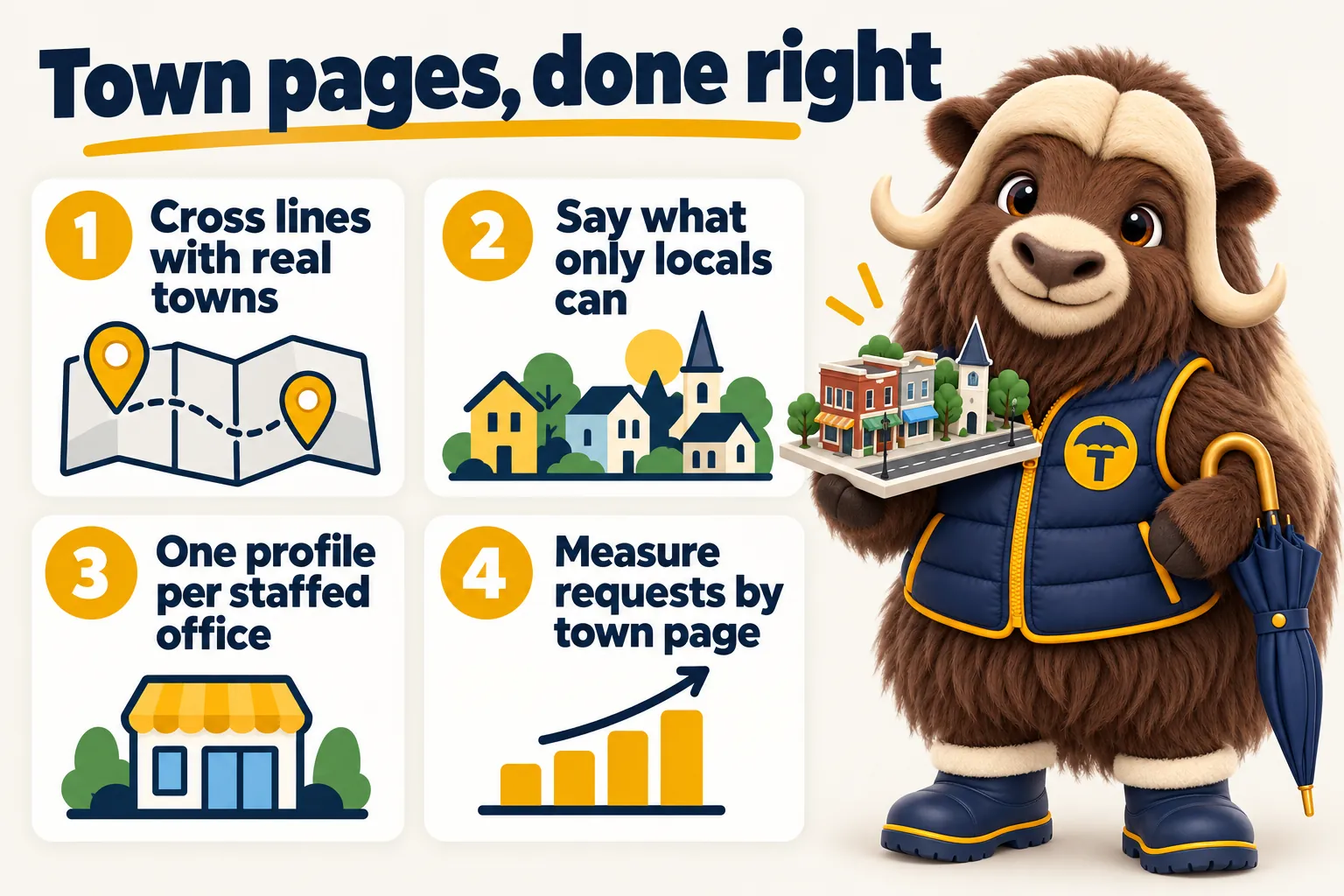
Local search is how an independent agency with a handful of producers competes against national carriers and directories, and the way it is won is unglamorous: a real Google Business Profile for each real office, a set of pages that cross the lines you write with the towns you actually serve, name and address and phone details that match everywhere they appear, and a way of measuring the result that counts quote requests rather than rankings. This article covers the page model, how many pages is too many, what separates a useful town page from doorway spam, how to run the profile, and how to measure the whole thing honestly.
This article is general information about websites and local search for insurance agencies. GetInsuranceWebsite is a website design and management company. We are not an insurance agency, broker, carrier or licensed producer, and nothing here is advice about coverage, rates or eligibility. It is also not legal or advertising compliance advice; what you may say about your agency and your appointments in a given state is a matter for your own advisers and your carriers.
How local search actually works for an agency
Two different results compete for the same local search, and they are won in different ways. The map results, drawn from Google Business Profiles, are decided largely by the profile itself, the searcher’s proximity to the business and the signals that support the business being real and active. The ordinary blue link results below them are decided by pages, and that is where a website earns its keep. An agency that only works on one of the two leaves the other on the table.
Google’s own guidance on improving local ranking describes the map side in terms of relevance, distance and prominence. You cannot change a searcher’s distance from your office. You can change how completely and accurately your profile describes what you do, and you can change how much genuinely useful material exists about your agency serving that place, which is the page side of the problem.
What the website can influence
The website influences the organic results directly and the map results indirectly. Directly, because a page that answers a specific local question about a specific line can rank for that query on its own merits. Indirectly, because a profile that links to a page genuinely about that location and those services is a more coherent, more verifiable business than one that links everything to a home page. The two halves reinforce each other, and neither works well alone.
The competition is not who you think
The competitor for a local insurance search is rarely the agency across the street. It is a national comparison site, a carrier’s own find-an-agent page, and a directory with thousands of thin location pages. That sounds discouraging and it is actually the opportunity, because none of those can write a page that says what it is like to insure a specific kind of property or a specific trade in a specific town, and none of them can put a named local producer’s photograph on it. Specificity is the only advantage a five-person agency has, and it is a real one.
The line crossed with town model
The page model that works is lines crossed with towns: a page per line, a page per town, and a page for the combinations that matter. The line pages carry the coverage substance. The town pages carry the local substance. The crossed pages exist only where the combination is a real thing people search for and the agency has something real to say.
Why the cross exists at all
The cross exists because people search that way. Somebody who needs coverage searches for the coverage and the place in the same query, because the place is part of the requirement. A page that carries only the line answers half of that, and a page that carries only the town answers the other half. Where the agency writes a lot of one line in one place, a page that carries both answers the whole query and tends to produce a much better quote request, because the person arrives having already seen that you serve their place and write their line.
Not every cell in the grid
Building the full grid is the most common way agencies ruin their own local search. Every line multiplied by every town is a large number, and almost all of the resulting pages describe queries nobody makes, written from a template nobody read. That pattern is exactly what Google’s spam policies describe as doorway pages, and a site carrying dozens of them looks less trustworthy overall, not more visible.
Build the cross selectively. Start from where the agency actually writes business: pull the book by town and by line and look at where the volume is. Those combinations are the ones worth a page, because they are the ones you can write with substance and the ones most likely to match real demand.
Three tests before you write a page
Before committing to a town page, or a line crossed with a town, ask three questions. Does the agency have a genuine presence there, meaning clients, a producer, an office within a normal driving distance, or an appointment that matters locally? Can you write something specific and true about serving that place that a competitor could not copy? And will somebody keep it current when the producer changes or the office moves? If the answer to any of them is no, skip the page. A smaller set of pages that pass all three will beat a larger set that does not, every time.
How many pages is too many
Too many is the point where you cannot write the next page with real substance or keep the existing ones current. That threshold is set by the agency’s capacity, not by a number anyone can hand you.
Count producers, not towns
A useful rough gauge is that local pages need a named human behind them. If a town page names a producer who covers that area, describes the mix of business the agency writes there and answers questions that come up locally, then the number of town pages the agency can honestly support is bounded by the number of producers and the areas they genuinely cover. An agency with three producers covering a county does not have forty towns worth of distinct material, and pretending otherwise produces forty pages of nothing.
The signals you have over-extended
You have gone too far when the pages start writing themselves. If the next page can be produced by find and replace, it is a doorway page. If nobody at the agency can tell you who covers that town, it is a doorway page. If the page has been live for a year and has produced no requests and no impressions, it is not earning its place. And if maintaining the set has become a chore nobody does, the whole set will drift out of date, which is worse than never having built it.
Pruning is part of the work
Pages that produce nothing over a long period should be improved or merged, not left to sit. Merging three empty neighbouring town pages into one honest regional page usually produces a better page than any of the three were. This is ordinary editorial maintenance and it is one of the things we handle as part of the ongoing work on the sites we run, rather than leaving a set of pages to quietly rot after launch.
What makes a town page genuinely useful
A town page is useful when it contains things only an agency that serves the town would know. That is the whole test, and everything below is a way of passing it.
The local specifics that matter
Write about the realities that shape insurance conversations in that place, in general terms and without making predictions or promises. The building stock and typical property age, if it affects how homeowners conversations go. The trades and industries that make up the local commercial book. Whether the area is largely owner-occupied or has a lot of rentals. What a commute looks like and what that means for the personal auto conversations you have. Whether there are local requirements or common certificate requests that come up repeatedly for contractors working there. A producer who works that territory can list these in five minutes; nobody else can guess them.
Keep every one of these general and factual about your own experience of writing business, not a claim about what any reader’s rates or eligibility will be. That line matters, and a page that stays on the right side of it reads more credibly anyway.
The structure of a town page
A town page follows a similar answer-first shape to a line page. A headline naming the agency’s service in that town. An opening paragraph that says plainly that the agency serves the town, from which office, and which lines it writes most of there. The request path immediately after. Then the local substance, the lines you write there with links to each line page, the producer or office that covers the area with a real photograph and a direct contact path, practical details a visitor would use such as address, hours, parking and directions, and the form again at the end.
The links to the line pages are structural, not decorative. They are how the local page and the coverage substance join up, and they should run both ways, with each line page pointing back at the towns where you write the most of it. That reciprocal linking is a large part of what tells a search engine these pages belong to one real agency rather than a set of templates, and it is the same idea we covered in the piece on line of business page structure.
The wording that gives away a doorway page
Certain phrasings appear almost exclusively on pages written to catch a search rather than serve a reader. Sentences that stack the town name three times in a paragraph. Openings that begin by explaining what insurance is. Claims about being the best or cheapest in a town, which are unverifiable and, depending on your state, may cause you problems with your own advertising rules. Lists of nearby towns in a footer with no context. Stock photography of a city skyline that is not the town. A page that carries any of these is announcing what it is.
The alternative is plain writing. Say what the agency does in the town, who does it, what is typical there, and how to ask for a quote. Google’s guidance on people-first content is the best short summary of the standard, and it happens to describe good agency communication generally.
Single office, service area, multiple offices
An agency with one office and a wide service area writes one office page and a modest set of town pages for the places it genuinely serves, all pointing at the same office. An agency with several staffed offices writes a real page per office, each with its own address, hours, staff and phone number, and routes the requests from each accordingly. The mistake to avoid in both cases is inventing a location page that implies an office where none exists. If the page implies a place a customer could walk into, a customer eventually will.
Google Business Profile
The profile is the highest-leverage local asset an agency has, and it costs nothing but attention. Set it up properly once and maintain it lightly.
One profile per real staffed location
Create a profile for each location that is genuinely staffed and reachable during the hours you state. Google’s guidelines for representing your business are explicit that virtual offices, mailboxes and addresses that are not staffed do not qualify, and profiles that break those rules risk suspension. An agency serving several towns from one office sets a service area on that single profile rather than creating locations it does not have. That is precisely what the service area feature is for.
Categories, services and hours
Choose the most accurate primary category for what the agency mainly does and add secondary categories only where they are genuinely accurate. List the lines you write as services, using the names buyers use. State hours honestly, including the ones you keep during holidays, because a profile that says open when the door is locked produces exactly the kind of experience that generates a one-star review. Keep the description plain and factual: who the agency is, what lines it writes, which areas it serves, and how long it has been doing it.
Photos, posts and questions
Add real photographs of the real office, the real staff and the real street frontage, because they help a visitor recognize the place and they are the most obvious signal that a listing belongs to a genuine local business. Use posts sparingly and for things that matter locally, such as a change in hours or a genuinely useful local reminder. Watch the questions section, because anybody can ask and anybody can answer, and an unanswered or wrongly answered question about your agency sits there indefinitely.
Reviews
Ask clients for reviews as an ordinary part of doing business, at the moment when you have just done something well, such as after a policy is bound or a claim is handled. Reply to every review you get, briefly and without ever discussing a client’s coverage, claim or personal details in a public reply. Never offer anything in exchange for a review and never write them yourself; both are against the guidelines and both are easier to detect than people expect. If your carriers or your state impose rules about testimonials in advertising, follow those too, and have your compliance adviser look at your review request wording before you start sending it.
Where the profile should point
Point the profile’s website link at the page that matches the location rather than the site’s home page. For a single-office agency that is usually the contact or office page. For a multi-office agency it is that office’s page. Where the profile lets you link specific services, point them at the matching line pages. This is the join between the two halves of local search, and it is also the point at which requests start becoming traceable, because a click from the profile to a location page and then into a form is a path you can actually count.
NAP consistency, in practical terms
Write the agency’s name, address and phone number identically everywhere they appear, and keep a list of everywhere they appear. That is the whole discipline, and it is more about operations than about search.
Pick the canonical form and write it down
Decide the exact form once. Whether the name includes the legal suffix. Whether the street is spelled out or abbreviated. Whether the suite number appears on its own line. Which phone number is the public one. Put that canonical block in a document, and use it every time anything is created, from a new directory listing to a carrier locator profile to a letterhead.
Everywhere it has to match
The list is longer than most agencies expect: the website footer and every location page, structured data in the page markup, the Google Business Profile, Apple and Bing equivalents, each carrier’s own agency locator, any association or trade body directory, review sites, social profiles, chamber of commerce listings, the phone directory data providers, and anywhere an old website or a previous agency name still lingers. Old listings from a prior name or a prior address are the usual source of trouble, and they need to be found and corrected or removed rather than ignored.
Suite numbers, tracking numbers and moves
Three details cause most inconsistency. Suite and unit numbers, which get dropped by some systems and added by others. Call tracking numbers, which are useful for measurement and become a problem when a tracking number is published as the business’s main number in one place and the real number appears in another; if you use tracking, keep the primary listed number consistent and use tracking in controlled places. And office moves, which require a deliberate sweep through the entire list rather than a change to the website and a hope.
Structured data
Mark up the agency’s details in the page markup using the local business structured data that Google documents, with the same values as the canonical block. It does not create a ranking on its own, and it removes ambiguity about which business the page describes, which is the entire point of the exercise. Keep the marked-up details and the visible details identical, because marking up something the page does not show is both pointless and a policy problem.
Measuring local search without fooling yourself
Count quote requests by page and by line, in the system where the requests land. Everything else is supporting evidence.
The number that matters
If a town page produced no quote requests in a quarter, it did not work, whatever any tool says about its position. If it produced steady requests from a modest amount of traffic, it worked very well, and it deserves more internal links rather than a rewrite. Getting this number requires that every form carries its source page and its line into the CRM or AMS, which is the point of doing the integration work properly in the first place. Without that, local measurement is guesswork dressed up in charts.
The supporting evidence
The Search Console performance report tells you which queries a page appears for, how often, and whether that is growing. Read it per page, not in aggregate, because the aggregate hides the two pages doing all the work. The Google Business Profile insights tell you about calls, direction requests and website clicks that originated at the profile, which is the map half of the picture. Together they explain why the request numbers moved.
What to ignore
Ignore third-party rank trackers reporting a single national position for a local query, because local results genuinely vary by the searcher’s location and no one number describes them. Ignore total site traffic as a local metric, because a blog post that goes mildly viral will swamp the signal you care about. And ignore any benchmark from a vendor’s marketing about what agencies typically achieve, because it was measured on someone else’s book, staff and market.
A sensible cadence
Look monthly and judge quarterly. Local pages take time to be crawled, indexed and trusted, and reacting to four weeks of data usually means undoing something that was about to work. Each quarter, list the local pages that produced requests, the ones that produced impressions but no requests, and the ones that produced nothing, then improve the middle group and merge or rewrite the last one.
Where to start
Start with the profile, because it is free, fast and the highest leverage thing on the list. Claim and complete it, fix the categories and hours, add real photographs, set the service area honestly and point the website link at the right page. Then fix NAP consistency, starting with the carrier locators and the directories that already carry the old details.
Only then build pages, and build them in this order: the office page for each real location, the line pages for the lines you write, then a small number of town pages for the places where you genuinely write business, then the crossed pages for the handful of line and town combinations that carry the most of your book. Link them all together in both directions. Add more only when one of the existing ones proves it earns requests.
That is the sequence we follow on the sites we build, and it is why the agency types pages and the plan pages both treat location pages as structural rather than as an upsell. The plans include the weekly updates that keep the towns, the producers and the office details current after launch, and if you would rather see the model applied to your own book before deciding, book a demo and we will go through it with your towns and your lines on the screen.
Sources
- Google Business Profile Help, Guidelines for representing your business on Google
- Google Business Profile Help, Improve your local ranking on Google
- Google Search Central, Local business structured data
- Google Search Central, Spam policies for Google web search
- Google Search Central, Creating helpful, reliable, people-first content
- Google Search Console Help, Performance report
Frequently asked questions
How many town pages should an independent insurance agency website have?
As many as the agency can write with real local substance and keep current, which for most independent agencies is a modest number rather than dozens. A practical ceiling is the set of towns where the agency has a genuine presence: where it has clients, where a producer works or lives, where the office is within a normal driving distance, and where the agency can say something specific and true about writing business there. If a town fails all of those tests, the page will be a template with a name swapped into it, and pages like that do not rank and do drag on the pages that do.
What makes a town page genuinely useful rather than doorway spam?
Content that could only have been written by an agency that actually serves that place. That means naming the local realities that affect the lines you write there, describing the mix of business you write locally, naming the producer who covers it and the office that serves it, and giving directions, parking and hours that a real visitor would use. Doorway pages fail the opposite test: swap the town name and the page is identical, there is nothing on it a local reader would recognize, and it exists only to catch a search rather than to serve the person who made it. Google's spam policies name that pattern directly.
Does an insurance agency need a Google Business Profile for each office?
One profile for each real, staffed location that customers can visit or contact during stated hours, and no profiles for anything else. A virtual office, a mailbox, a coworking desk you rent by the hour or a producer's home address used purely to claim a second town are all against Google's guidelines for representing a business, and the consequences of being caught run from the listing being suspended to the whole account being affected. An agency with one office and a service area covering several towns sets the service area on that one profile rather than inventing locations.
What is NAP consistency and why does it matter for an insurance agency?
NAP is the agency name, address and phone number, and consistency means writing them identically everywhere they appear: the website footer, every location page, the Google Business Profile, carrier agency locators, association directories, review sites and social profiles. It matters because the systems that decide which local business a search result points at have to be confident that every mention refers to the same business, and inconsistent details make that harder. It matters practically too: a phone number that is wrong on a carrier locator sends your prospects to a disconnected line, and nobody involved ever finds out why the calls stopped.
Should every line of business be crossed with every town the agency serves?
No. The full grid of every line multiplied by every town produces a large number of pages that nobody can write well or keep current, and most of the cells describe searches that nobody makes. Cross the lines that matter in a town with the towns where that line matters. A page about workers compensation for contractors in a town with a large trade base earns its place; the same line crossed with a town where the agency has two personal auto clients does not. Start with the handful of combinations that match where the agency actually writes business, and add more only when one of them proves it works.
How do you measure whether local pages are working?
Count quote requests by town page and by line, month over month, in the agency management system or CRM where the requests land. That is the only number that pays for anything. Support it with the Search Console performance report to see which queries each page appears for and whether impressions are growing, and with the Google Business Profile insights to see calls, direction requests and website clicks from the profile. Ignore third-party rank trackers reporting a position you personally never see, because local results vary by the searcher's location and history, and a position you cannot tie to a request is not a result.
Want a site like the one described here? Book a demo with GetInsuranceWebsite.